Explore how Viking Vietnam controls critical details in technical jacket manufacturing, from construction and materials to zippers, pockets, seam sealing, quality control and finishing.
Seen from the outside, a technical jacket can look fairly simple. Look into its construction, though, and it is a product built from a great many connected details: shell fabric, lining, insulation where used, zips, pockets, hood, cuffs, drawcords, reflective material, logos, seam tape, reinforcement, labels and the packing specification.
Every one of them has a function. And a single small point executed wrongly can affect how the whole garment is used or how it performs.
That is why making a technical jacket is not simply sewing a coat. It is the business of controlling a great many small details so that, in the end, a large product works exactly as designed.
1. Quality starts from understanding what the product is for
Before discussing a seam, it is necessary to understand the conditions in which the wearer will use the garment. A jacket for outdoor workers, cold environments, prolonged rain, high intensity activity, hunting, military use, firefighting support or outdoor performance each carries different requirements.
That affects the construction, the materials, pocket positions, the type of zip, the level of reinforcement, adjustability, waterproofness, breathability and visibility.
Before production, therefore, technical has to understand the function of each detail, not only its shape. When the person executing understands why, they are usually more likely to get it right than when they know only how.
2. The pattern decides more than the shape
A pattern does not only create the silhouette. It also affects freedom of movement, the position of functional elements, the balance of the garment, how the material layers meet, how easily it can be sewn, how easily it can be seam sealed, and material consumption.
A small change to the pattern can affect many later steps. A curve that is too tight can make the handling difficult. A point where several components meet can create a thick area. A badly placed seam can make taping hard.
Sample development and fitting are therefore not only about appearance. They are also a test of whether the garment can be manufactured.
3. The zip is a small detail with a large effect
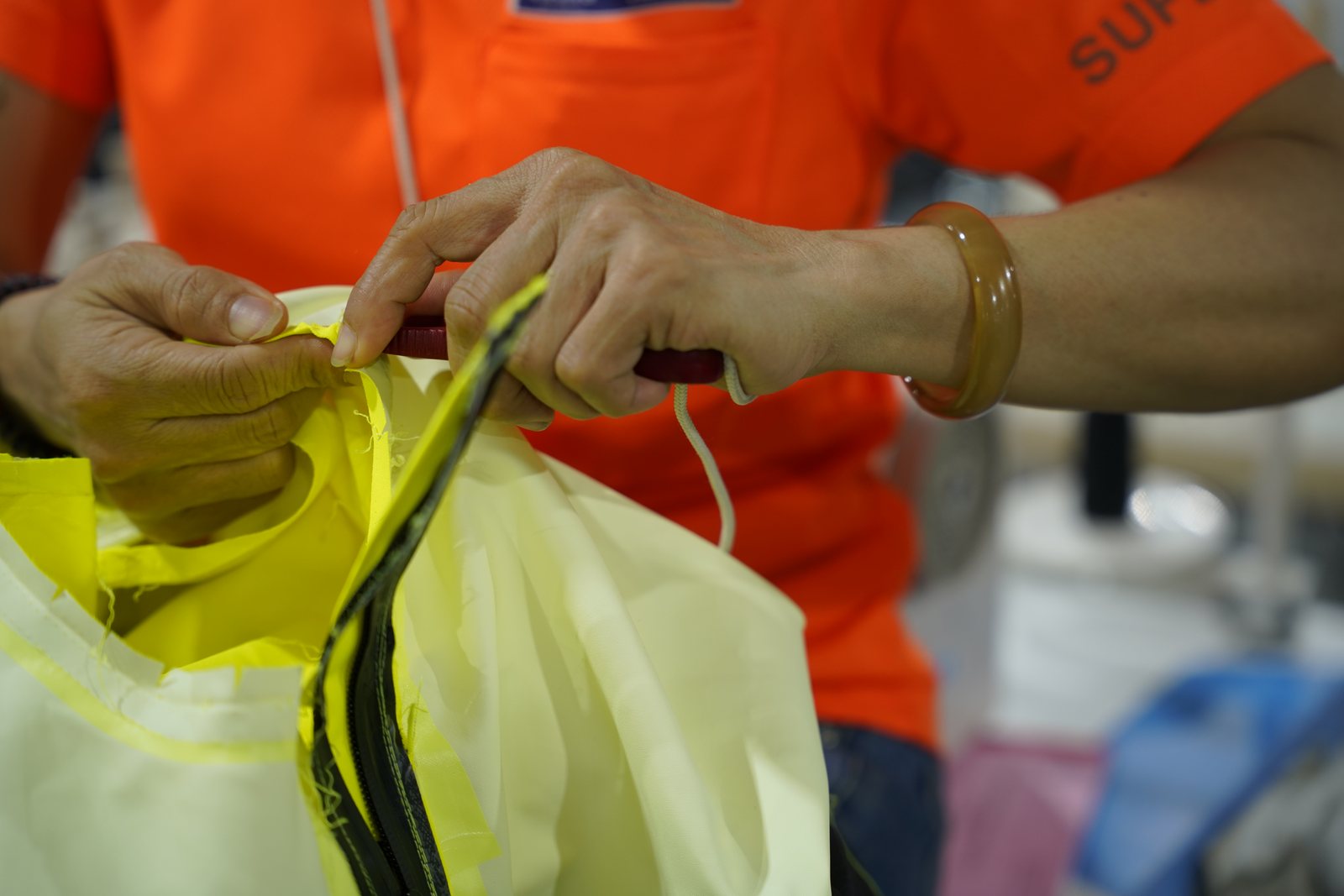
On a technical jacket the zip usually carries an important role. It may be a front zip, a waterproof zip, a pocket zip, a ventilation zip or a two way zip.
A zip has to be controlled on several points: the correct code, the correct colour, the correct length, the correct position, the correct direction, balance between the two sides, no waving, no jamming, and a correctly finished top end.
If a zip sits a few millimetres out, the garment can look unbalanced. If the setting operation is inconsistent, the effect on appearance is very visible.
With a waterproof zip the requirement is higher still, because the zip can relate to the garment's water resistance. That is why a zip has to be treated as a critical component, not as decorative trim.
4. A pocket has to look right, but function comes first
A technical jacket often carries several kinds of pocket: chest, side, sleeve, internal, cargo style and radio pockets.
A pocket has to meet several requirements at once: the correct position, the correct size, easy use, balance between the two sides, adequate reinforcement, no interference with movement, and no weak point introduced into the waterproof construction.
This is one of the areas where many small details concentrate. With a zip, a flap, bartacks and several fabric layers, the complexity rises quickly. At the technical stage and at the first piece, pocket construction therefore needs close control.
5. The hood is one of the hardest parts of technical outerwear
A hood can look like a separate component. But it directly affects vision, head movement, rain protection, adjustability, compatibility with a safety helmet where relevant, and the shape of the garment.
Its details can include drawcords, cord locks, a peak, adjustment tabs, hook and loop fastening, elastic and cord channels.
On a waterproof jacket the hood also carries many seams that need sealing. That raises the need for coordination between pattern, sewing and seam sealing. A hood that looks good but is awkward to use is still not a good hood.
6. Cuffs and hems are where comfort meets protection
A cuff may use hook and loop fastening, elastic, an adjustment tab or an inner cuff. A hem may have a drawcord, elastic cord, a stopper and a channel.
These details affect how the garment feels and how well it protects. If the cuff is too wide, water or wind can enter. Too tight, and the wearer cannot move freely. If the stopper is fitted wrongly, the adjustment stops working.
It is a clear illustration of how a small trim can have a large effect on the user's experience.
7. Reinforcement has to appear exactly where the load is
Workwear and outdoor products usually have areas that take more impact: the elbow, the shoulder, the pocket opening, the cuff, the hem, the knee on trousers, and tool attachment points.
These positions may need reinforcement fabric, bartacks, additional stitching, a patch or an extra layer.
But reinforcement is not a case of more being better. Too many layers can make the garment heavy, stiff or hard to seal. Design and technical therefore have to balance strength, comfort and manufacturability.
8. Reflective placement has to be accurate
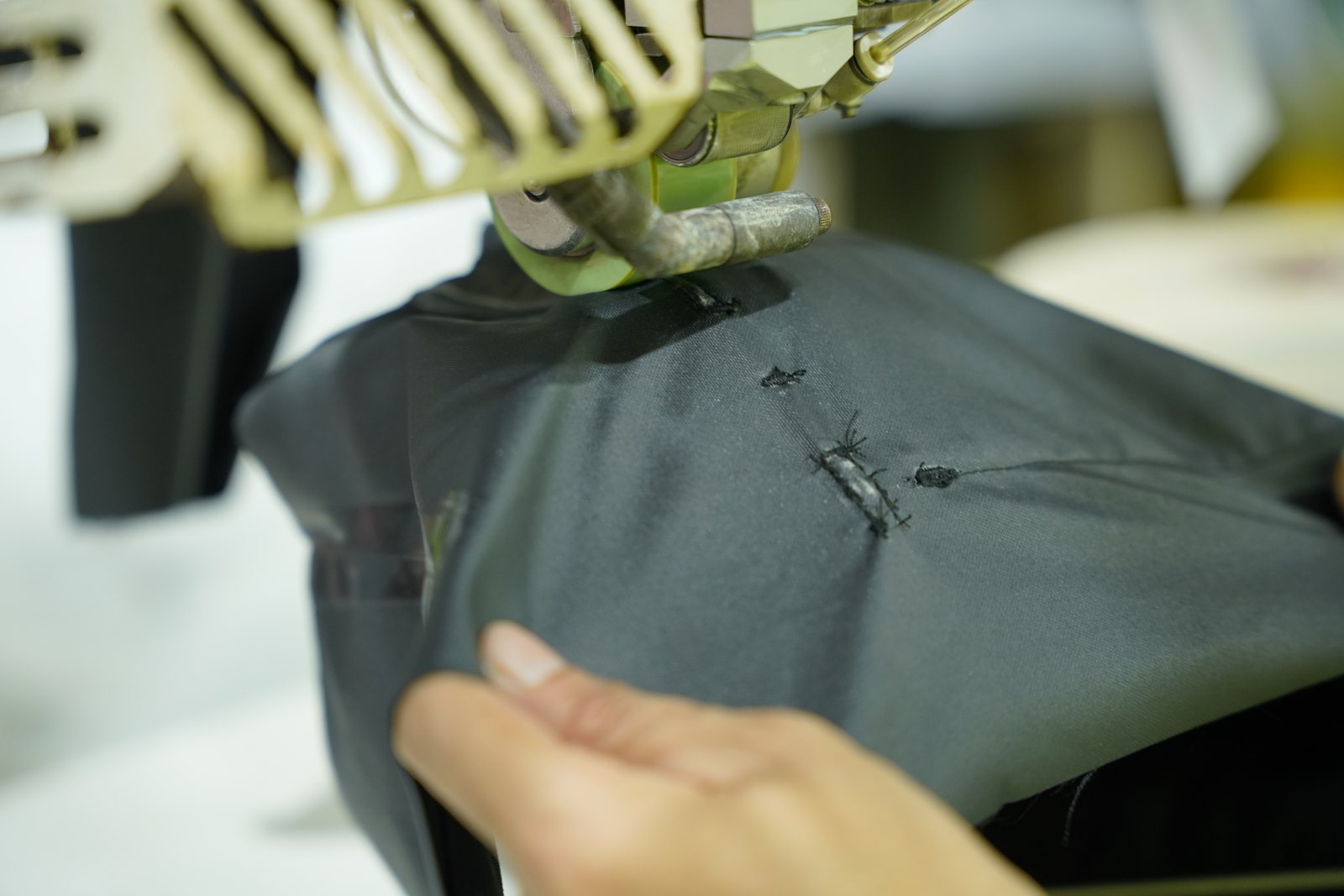
On some workwear and protective clothing, reflective material can relate to how visible the wearer is.
Control is not only about whether the reflective is present. It covers the position, the spacing, the straightness, the symmetry, the seam intersections, how curved areas are handled, and the appearance after sewing.
If reflective is placed wrongly, the garment may no longer match the approved design. This is why QC needs specific check points for this group of details.
9. Seam construction directly affects the sealing step
On a waterproof jacket, sewing and seam sealing cannot be separated. If the preceding stitch line is inconsistent, with uneven seam allowance, puckering, corners that are too thick or layers overlapping badly, the sealing that follows will struggle to be consistent.
It is a clear illustration of the principle that quality at the next process begins at the previous one.
The sealing area should not be left correcting problems created in sewing.
10. Multi layer intersections have to be identified in advance
One of the hardest parts of a technical jacket is where several components meet: zip plus pocket plus facing, hood plus collar plus seam, shoulder plus reinforcement, cuff plus tab plus seam allowance, or several seams crossing at one point.
These areas can create great thickness, difficulty holding the components, harder needle penetration, harder sealing and uneven appearance.
Technical therefore has to identify them at the sample stage. They should not be discovered in bulk production.
11. IE has to see difficulty, not only minutes
Analysing a technical jacket, IE does not only break down operations and calculate standard time. It has to identify which operations need high skill, which are likely to become bottlenecks, which need a specialised machine, which need an attachment, which need training beforehand, and which carry special QC requirements.
Two operations with almost the same time can carry entirely different risk. Time data therefore has to be combined with technical understanding.
12. Inline QC catches a defect while it is still small
A defect on a technical jacket found at the end of the line can be very expensive, particularly when it involves the zip, a pocket, the hood, seam sealing, reflective or measurements.
Unpicking and repairing can affect several material layers or change the appearance. That is why inline QC matters.
QC has to check at the moment the defect is created. On spotting an abnormal trend, feedback has to come early so the defect does not spread.
13. The first piece is where the details are seen as one system
At the first piece, the parts should not be checked only in isolation. The whole garment has to be looked at:
- Is the jacket balanced?
- Does the zip run well?
- Is the hood in the right position?
- Is the pocket convenient to use?
- Are the measurements correct?
- Are the critical seams sound?
- Is seam sealing feasible?
- Is the reflective in the right position?
- Does the packing requirement fit?
The first piece is where the small details meet for the first time under real production conditions. It is an important opportunity to confirm before scaling up.
14. A small defect becomes a large one once it is multiplied
Suppose a pocket sits five millimetres out of position. On one garment that may not be a serious problem. On five hundred garments made by the same wrong method, it is an entirely different matter.
This is why technical apparel has to watch for the first signals. A small deviation that repeats is the signature of a process issue.
The factory has to care about repeatability, not only about one good sample.
15. Finishing is also part of technical quality
When the jacket leaves the line, the work is not over. The garment has to be examined for appearance, measurements, thread trimming, cleanliness, functional components, zip operation, labels, logos, folding and packing.
A good technical product should not lose value through careless finishing. The customer sees the finished garment. Finishing is therefore where the effort of all the earlier operations shows.
16. Technical jacket quality is the result of many roles
A technical garment is not created by one skilled operator. It is the product of a whole system:
- Merchandising: understands and conveys the customer requirement.
- Technical: turns the design into a production construction.
- Sample room: tests the approach.
- Materials and warehouse: secure the correct materials and trims.
- IE: designs the method and the flow.
- Maintenance: prepares the equipment.
- Production: executes.
- QC and QA: control and confirm.
- Finishing: completes the garment before delivery.
Final quality is the accumulated result of all of these.
The value for international customers
Assessing a technical outerwear factory, a customer can look further than capacity. Some more useful questions are:
- How does the factory identify critical construction?
- How is a complex pocket prepared?
- Where is the zip controlled?
- Is seam sealing connected to sewing?
- Which functions confirm the first piece?
- How are operators prepared for the difficult operations?
- What does inline QC focus on?
- How are repeated defects handled?
These questions help assess the technical depth of a factory's capability.
Viking Vietnam: large quality is built from small details
In technical outerwear there are not many details that do not matter. A zip, a bartack, a stopper or a length of seam tape each exists for a reason.
Viking's approach can be summarised as a chain: understand the function, control the detail, verify the process, train the people, check at source, confirm the finished garment.
A good jacket is not created by one outstanding movement. It is created when hundreds of small details are all done correctly, often enough.
That is the technical depth of technical apparel manufacturing at Viking Vietnam.