Explore why high performance apparel manufacturing at Viking Vietnam depends not only on machinery, but also on materials, engineering, IE, quality control, training and cross-functional coordination.
Assessing a garment factory, the first question is usually how many lines it has, or what machines it owns. Those are necessary questions. But for high performance apparel, they do not yet describe real capability.
A waterproof jacket, a piece of technical workwear or a protective garment may use several kinds of specialised machine. But equipment only produces good results inside a system made up of: materials, technical know how, process engineering, trained people, machine readiness, quality control, testing and continuous improvement.
That is why capability in technical apparel has to be seen more widely than a machine count.
1. How high performance apparel differs from ordinary garments
High performance apparel is not designed only to be worn. It is made to perform a specific function in specific conditions of use.
Depending on the product, that function may include water resistance, wind resistance, warmth, moisture release, freedom of movement, abrasion resistance, visibility, protection of the wearer and operation in harsh environments.
That changes how the factory has to see the product. A seam no longer only has to look neat; it may have to carry load. A zip does not only have to open; it may have to support water resistance. A fabric does not only have to be the right colour; it may have to meet a technical function.
Quality in high performance apparel therefore sits in both appearance and function.
2. Material is part of the product technology

On a technical product, material is not only an input. It is part of the function: laminated fabric, membrane, insulation, reinforcement fabric, reflective material, waterproof zips, seam tape, elastic systems and technical trims.
Each component can behave differently when cut, sewn, heat pressed, seam sealed, washed and used in the field.
The factory therefore has to understand not only what the material is but how it will behave during production. A good material handled unsuitably can still produce a garment that falls short.
3. Technical know how decides how the machine is used
Two factories can own the same machine and not get the same result. The difference lies in knowledge:
- Which needle should be used?
- What thread tension?
- What seam allowance?
- When is an attachment needed?
- How should a thick area be handled?
- Which seam tape suits?
- How should temperature, pressure and speed be confirmed?
- What does the operator have to be told?
The machine does not answer these questions. People have to understand the product in order to set the right conditions.
This is why Viking needs technical, IE, production, maintenance and QC working together when preparing technical product lines.
4. IE turns a complex design into something that can be made
A technical jacket can contain a great many operations. Dropping the product onto the line and letting the team work it out carries high risk.
IE has to analyse the operation breakdown, the sequence, the standard time, the machine requirement, the skill requirement, the layout, the bottleneck risk and the line balance.
But with high performance apparel, IE also has to understand that not every operation can be optimised by speed alone. A technical operation may need extra time to stay consistent.
Chasing seconds without considering quality can raise efficiency on the report while raising rework on the floor. IE therefore has to balance productivity, quality and process stability.
5. Machine readiness matters more than merely owning equipment
A factory with a machine that is not ready does not yet have the capability. Before a new style, maintenance and the related functions may need to prepare the right machine, needles, presser feet, guides, jigs, folders, the seam sealing machine, the heat press, any programming and the settings the material calls for.
Equipment that has not been prepared can stop the line. Or, more dangerously, production continues and quality is inconsistent.
Machine capability therefore has to be read through the question has the machine been prepared correctly for this product, not only whether the factory owns one.
6. Operator skill is the part equipment cannot buy
A good machine still needs a skilled operator, particularly on operations such as seam sealing, setting waterproof zips, complex pockets, curved sewing, reflective application, multi layer construction and technical finishing.
Operator skill directly affects consistency, appearance, speed, the repair rate and the ability to handle difficult materials.
That is why internal training weighs so heavily in high performance apparel. A business can buy a machine in a few weeks. Building a team that performs consistently usually takes longer.
7. Quality at source matters more than final inspection
A technical defect found at the end of the process can be very expensive to correct: a zip in the wrong position, a pocket built wrongly, misplaced reflective, inconsistent seam sealing, a measurement out of tolerance or missing reinforcement.
On a multi layer product, unpicking to repair can even risk damaging the material. Quality therefore has to be controlled as close to the source as possible.
Inline QC checks the first piece, checks the handling, compares against the approved sample, tracks defects on the line, feeds back early and prevents a defect repeating.
The aim is not to wait at the end of the line to find defective garments. The aim is not to let a defect be mass produced.
8. Function has to be verified, not only looked at
A technical garment can look excellent. That alone does not prove its function.
Depending on the product programme, the factory may need to verify properties relating to waterproofness, seam integrity, adhesion, performance after washing, measurement stability, material performance and the customer's other test requirements.
What matters is that the criteria follow the specific requirement of the product. A test from one product should not be carried across to another without confirmation.
High performance apparel calls for the discipline of do not assume, verify.
9. Technical apparel needs more cross functional coordination
An ordinary product already needs several functions working together. Technical apparel needs the connection to be tighter still:
- Merchandising: clarifies the customer requirement.
- Technical: analyses the construction and the method.
- Sample room: verifies the product.
- Materials and purchasing: prepare the materials.
- Warehouse: controls and issues them.
- IE: designs the production flow.
- Maintenance: prepares the equipment.
- Production: executes.
- QC and QA: control and confirm.
If one function changes the information and the others do not update, risk appears. Capability in high performance apparel is therefore also capability in cross functional collaboration.
10. The first piece tests the whole system at once
A good first piece does not only prove that the operator can sew the garment. It tests the documentation, the pattern, the material, the method, the machine, the operator and the QC standard.
If the first piece fails, the question should not only be who got it wrong. It should be which condition in the system was not right.
That is the difference between correcting a person and correcting a system. On technical products, the second way of thinking holds its value far longer.
11. Traceability grows more important as products get more complex
The more materials and technical requirements involved, the more it matters to be able to trace information back. When a problem appears, the team needs to know which material was used, which lot, which document version, when it was produced, which conditions applied and what quantity may be affected.
Traceability does not only serve audits. It lets the business limit the scope of a problem and decide faster.
Without the data, a small defect can force the factory to inspect a very large scope.
12. Training is part of manufacturing capability
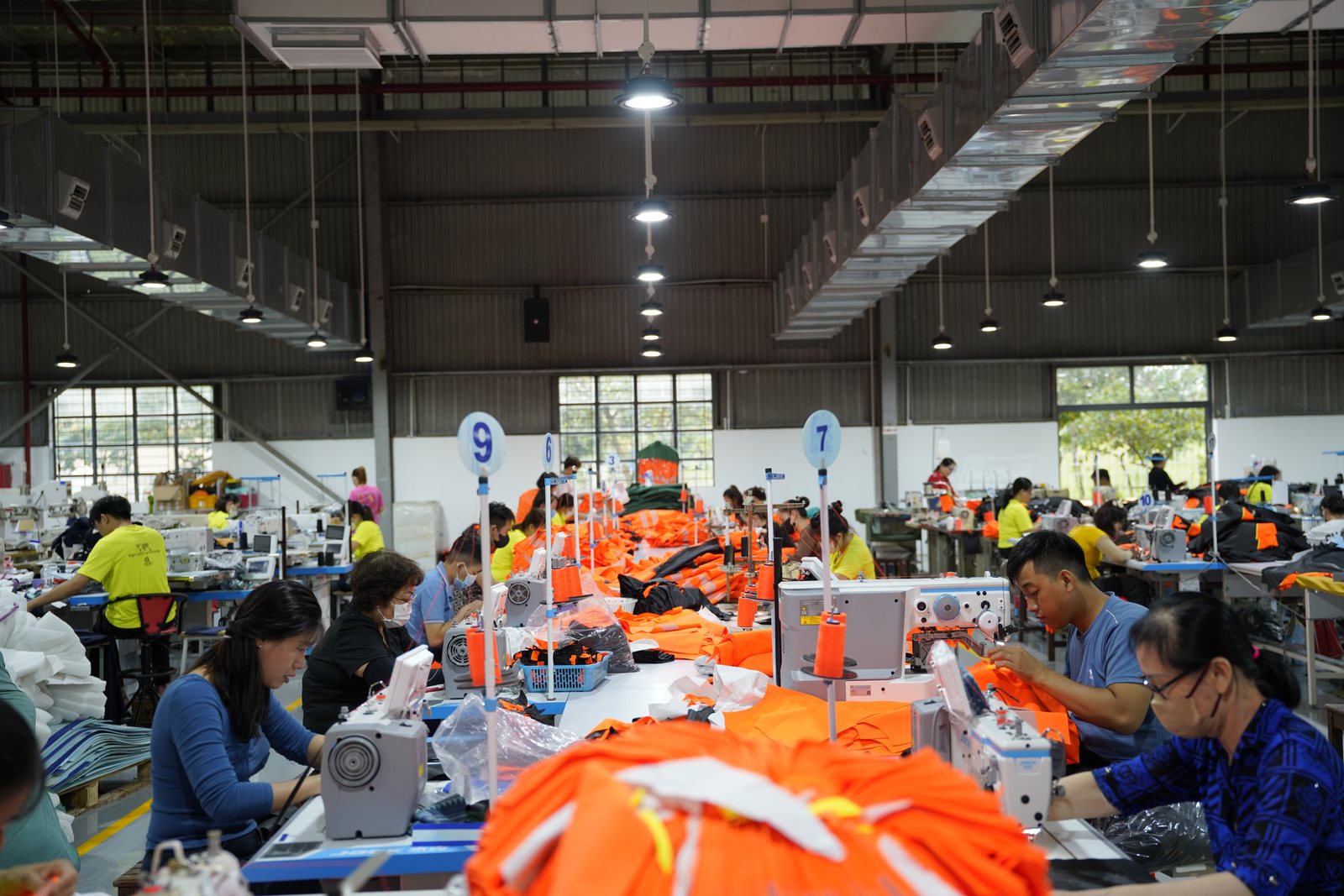
One mistake in talking about capacity is counting only machines, lines, workers and pieces per day.
Sustainable capacity also depends on how many people can run the difficult operations, how many can cover for one another, how long a new person needs to reach the required skill, whether the line leader can train, whether SOPs and video exist, and whether experience is retained inside the organisation.
If only one person can run an operation, that is a point of risk. A skill matrix and cross training are therefore part of capacity planning too.
13. Compliance does not sit outside production
High performance apparel is often used in environments where the demands on the product are higher. System discipline matters all the more.
Compliance shows in very concrete behaviour: using the correct documents, not substituting materials unilaterally, not passing over a defect to hit a quantity, reporting data accurately, stopping when something important is wrong, protecting customer information and following safety requirements.
Compliance is not a layer of paperwork sitting above production. It has to appear in the daily decisions of the people doing the work.
14. Data lets the factory learn from itself
When production data is recorded properly, the factory can see which defects repeat, which operations tend to block, which styles are harder than expected, what training operators need, which machines cause stoppages, which materials need watching and which operations need a better method.
Each order then produces more than garments. It also produces knowledge for the next order. That is how a factory builds capability over time.
15. Technology and AI only pay off on clear foundations
A factory can adopt ERP, MES, digital work instructions, a video library, data dashboards or an AI assistant. But if the process is unclear, the data unreliable and the responsibilities undefined, technology will not solve the problem by itself.
The sounder way to think about it is people first, AI alongside. People have to understand the work. The process has to be standardised. The data has to be trustworthy.
Only then does technology help the team work faster, find knowledge more easily and decide better.
16. Real capability is the ability to repeat the result
A beautiful sample can be made by one very skilled person. Manufacturing capability is proved when the factory can recreate the product, with many people, across many days, across many sizes, in larger quantities, and still hold the requirement.
That is repeatability. In high performance apparel, repeatability is usually worth more than a single moment of excellence. Customers need a partner who can produce a predictable result.
What customers should assess beyond the machine count
Visiting a technical garment factory, a buyer can add questions such as:
- What is the hardest operation on this product?
- Who analyses the risk before production?
- How are the operators trained?
- How is the first piece confirmed?
- Which points does QC check at source?
- When a defect repeats, who is responsible for investigating?
- How do technical and IE work together?
- How is the equipment prepared before a style?
- How does the factory retain lessons from previous products?
These questions usually reveal the depth of capability more clearly than counting equipment.
Viking Vietnam: machines create possibility, the system creates capability
High performance apparel demands a great deal of technology. But Viking Vietnam sees manufacturing capability as wider than equipment. It can be pictured as a chain: the right material, the right technical method, the right equipment, trained people, a controlled process, quality at source, verified function and continuous learning.
Machines make a job possible. People, knowledge, process and discipline are what make that job done correctly and repeated consistently.
That is why capability in high performance apparel does not sit inside a machine. It sits in the whole system behind the machine.
And it is the foundation Viking Vietnam keeps building for customers who need not only a garment factory, but a technical manufacturing partner able to understand the product, control the process and keep learning.