Learn how five key sewing line roles, including line leader, QC, IE, maintenance, and technical implementation, help Viking Vietnam control productivity, quality, and production stability.
In export garment manufacturing, international customers usually look at machinery, certifications, factory scale and production experience. These all matter.
However, when an order actually reaches the sewing line, stability does not come only from machines or technical documents. It comes from how people coordinate on the production floor.
A sewing line can have enough operators, enough machines and enough material, yet still carry real risk if the operating roles are not clear:
- An operation becomes a bottleneck but is noticed late
- A quality defect repeats without being resolved at source
- A machine stops and productivity suffers
- Technical implementation is unclear, so operators work inconsistently
- The line loses balance between groups of operations
- Actual output drifts away from the plan
- Departments handle problems separately, without connection
This is why a dependable garment factory cannot rely on one capable individual. It needs a system of clearly defined roles that work together.
At Viking Vietnam, production stability is built by several positions working together on the floor. Five of those roles are key: the line leader, QC, IE, maintenance and technical implementation.
1. The line leader sets the rhythm of production
The line leader stands closest to the daily rhythm of the sewing line.
In a production line, the line leader does more than assign work. The line leader has to watch the whole production flow, follow the condition of each operation, and recognise early the points that could affect schedule or quality.
The line leader's role includes:
- Allocating work to operators
- Following progress at each operation
- Identifying bottlenecks in the line
- Supporting operators when an operation is difficult
- Working with QC when a defect appears
- Discussing productivity and line balancing with IE
- Feeding back to technical when a method instruction is unclear
- Alerting maintenance when a machine is affecting production
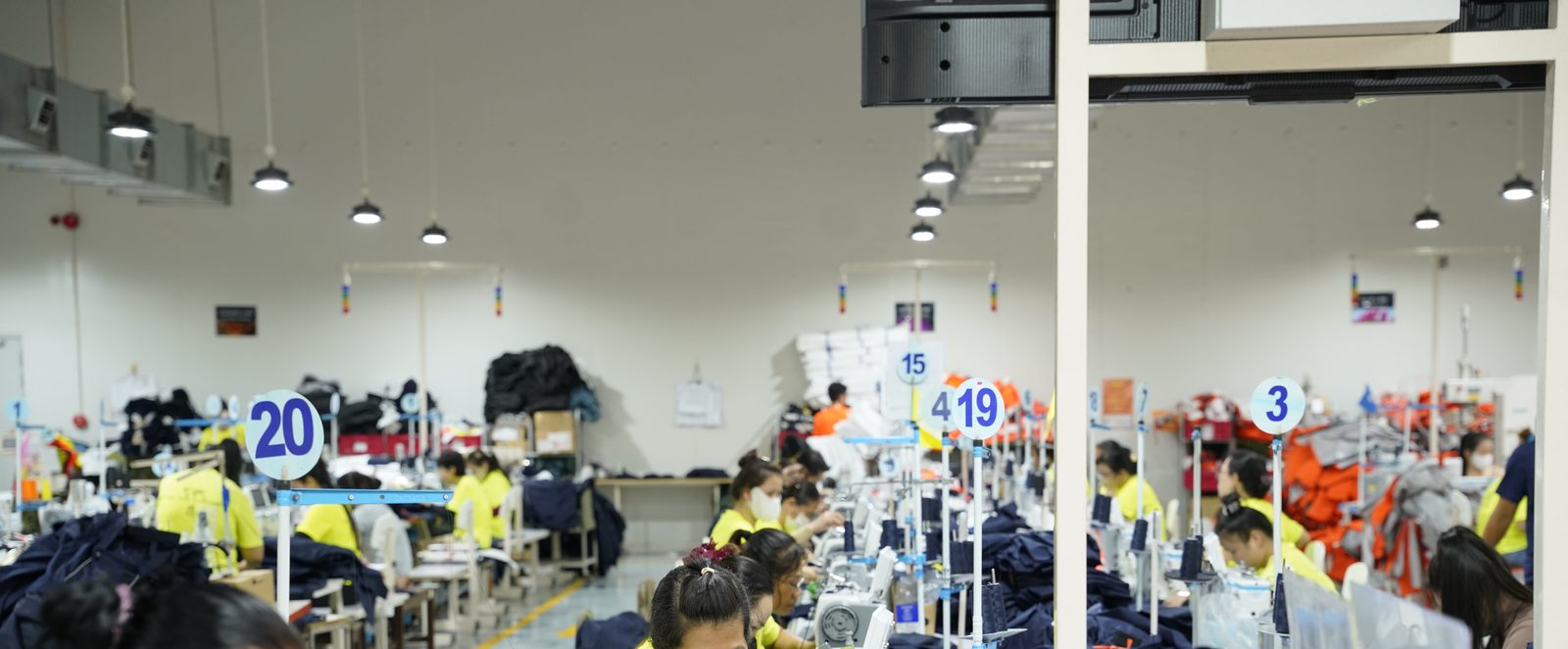
For customers, a capable line leader means the order is controlled more closely on the floor. Problems are not discovered only at the end of the day. Abnormal signals can be seen sooner and answered faster.
2. QC controls quality during production, not only at the end
In a garment factory, QC is not only the person who inspects the finished product. QC is an important part of the defect prevention system.
If quality is checked only at the end of the line, the factory may find defects too late. By then the quantity needing repair can grow, processing time stretches out, and the delivery schedule is affected.
QC's role on the floor includes:
- Inspecting products against the critical control points
- Detecting defects early during production
- Classifying defects clearly
- Feeding defects back to the line leader and technical
- Tracking whether a defect repeats
- Checking consistency between the approved sample and production
- Helping prevent defects before they spread
For technical products such as waterproof garments, protective workwear, reflective workwear or outdoor apparel, QC matters even more. A small defect can affect how the product performs, not only how it looks.
At Viking Vietnam, QC is an important link that lets quality be controlled from the floor rather than depending on final inspection alone.
3. IE lets the sewing line run on data
IE is the role that lets the factory see production in terms of process, time and data.
On a sewing line, the feeling that something is slow or blocked has to become concrete data before it can be resolved correctly. IE supports the factory in analysing operations, building the layout, tracking productivity and balancing the line.
IE's role includes:
- Analysing the sewing process
- Determining operation times
- Setting the machine requirement for a style
- Designing a suitable line layout
- Tracking productivity by operation or group of operations
- Analysing bottlenecks
- Supporting line balancing
- Keeping data current for production improvement
IE keeps the sewing line from running purely on intuition. Instead, decisions about operation layout, staffing and line adjustment rest on a clearer basis.
For international customers this is reassuring. An order implemented in a system supported by IE has a better chance of being controlled in terms of productivity, schedule and stability in bulk production.
4. Maintenance reduces interruption and keeps machines stable
In garment manufacturing, machines affect productivity and quality directly. An unstable sewing machine, a pressing device set to the wrong parameters or an unsuitable jig can slow the line, create defects or put pressure on operators.
Maintenance is therefore not only the department that repairs a machine when it breaks. Maintenance is part of the system that keeps production stable.
Maintenance's role includes:
- Preparing machines before the style reaches the line
- Checking machine condition during production
- Responding quickly when a machine stops or runs unevenly
- Adjusting machines to suit the material and the operation
- Working with IE and technical on equipment needs
- Supporting jigs, templates or devices that improve an operation
- Reducing waiting time caused by machine problems
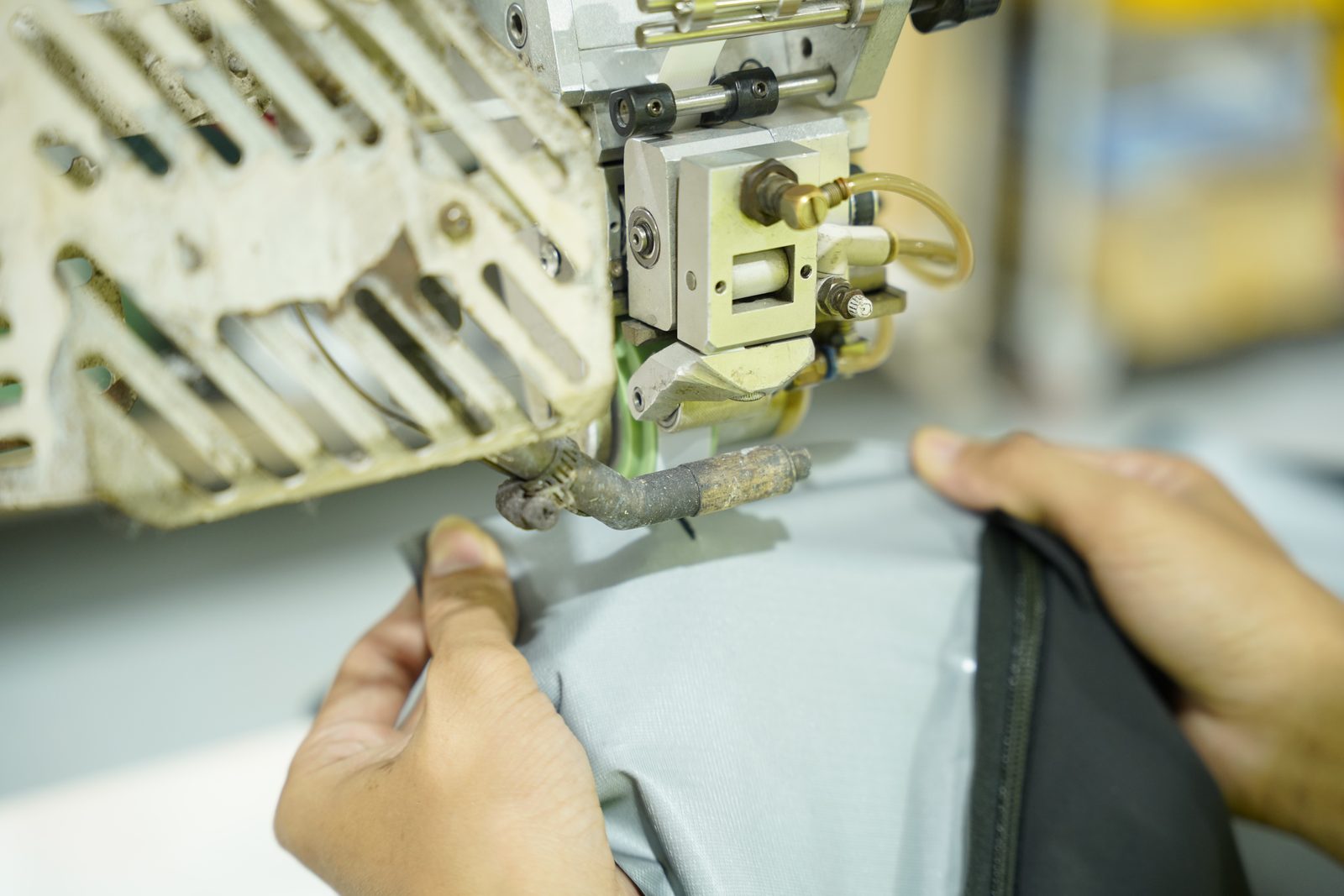
For technical products, maintenance matters even more. Some materials, trims or special operations need the machine adjusted accordingly. If the machine is not right, the product may not reach stable quality even when the operator works carefully.
At Viking Vietnam, maintenance is an important part of the factory's ability to react quickly on the floor.
5. Technical implementation turns a product requirement into a clear operation
Customers can provide technical files, approved samples, measurement charts and quality requirements. But for the sewing line to produce correctly, those requirements have to become specific instructions that are easy to understand and suited to the reality of the line.
This is the role of technical implementation.
Technical implementation has to ensure that:
- Operators understand the correct way to perform the operation
- The line leader knows the difficult points of the product
- QC knows which points need special control
- IE has the information to analyse operations more accurately
- Maintenance understands the equipment requirement or machine adjustment
- Technical changes are communicated clearly to the line
- The pilot piece is controlled before bulk production starts
For products with seam sealing, reflective tape, insulation, laminated materials, waterproof details or protective requirements, technical implementation matters even more.
An unclear instruction can produce several different interpretations. Several different interpretations lead to inconsistent quality.
At Viking Vietnam, technical implementation makes sure the customer's requirement becomes a real production method that is clear and controllable.
6. The coordination between the five roles is what creates real operating capability
Every role on the sewing line matters. However, the greatest value is not in each role separately, but in how the roles work together.
A well run sewing line needs these connections:
- The line leader sees the daily rhythm of production
- QC detects defects and feeds quality back
- IE analyses data and balances the line
- Maintenance keeps machines stable
- Technical implementation guides the correct production method
When these five roles coordinate well, the factory can resolve problems faster:
- Defects are found sooner
- Bottlenecks are identified more clearly
- Machines are supported more promptly
- Operators get more specific guidance
- Productivity is tracked more closely
- Quality is controlled better at source
For customers this is an important signal. A factory with a clear system of coordination is more dependable than one that only reacts after a problem has already happened.
7. The start of day meeting keeps the roles aimed at one target
In production, if each department understands the target differently, the sewing line easily drifts apart.
The start of day meeting is one way to bring the main roles to a shared target:
- Which style is in production
- What the output target for the day is
- Which operation needs attention
- What yesterday's defects were
- Which bottleneck has to be resolved
- Which machines need preparing
- Which people need support
- Which quality requirement needs repeating
When the information is shared clearly at the start of the day, the line has a better basis for working in step.
At Viking Vietnam, clarity in daily communication is an important part of production management. A factory does not only need capable people; it needs a system that lets capable people coordinate properly.
8. Tracking during the day lets the factory adjust in time
Bulk production cannot be judged only at the end of the day. If the factory learns only at the end of the day that output fell short or defects rose, most of the chance to adjust has already gone.
Tracking during the day therefore matters a great deal.
The information that needs updating includes:
- Actual output at each point in the day
- Which operation is running behind
- Defects arising during sewing
- Whether machines are affecting the schedule
- Whether operators need support with an operation
- Whether work in progress is piling up at any group of operations
- Whether the end of day target needs a revised support plan
When data and observation are updated regularly, the main roles can coordinate a response faster.
This keeps the factory from being caught out. Instead of waiting for a problem to grow, the team can act as soon as an abnormal signal appears.
9. Operating capability shows in how problems are handled
No factory is entirely free of problems in production. What customers should care about is not whether a factory ever has a problem, but how the factory handles it.
A sound operating system needs the ability to:
- Recognise a problem early
- Identify the cause correctly
- Assign the right role to resolve it
- Respond quickly on the floor
- Follow the result after resolution
- Draw the lesson so it does not repeat
When the line leader, QC, IE, maintenance and technical implementation work together, the factory has more perspectives available to solve the problem.
QC looks from quality. IE looks from data and flow. Maintenance looks from the machine. Technical looks from the method. The line leader looks from people and the rhythm of production.
This combination lets Viking Vietnam control production as a system rather than handling each incident on its own.
10. Why customers can feel more confident when roles are clearly defined
For international customers, a dependable manufacturing partner has to secure several things at once: quality, schedule, responsiveness, transparency and consistency between orders.
A clear system of roles on the sewing line gives customers more confidence because:
- Production is controlled directly on the floor
- Each problem has a role responsible for it
- Productivity and quality data are connected to real action
- Machines, technical, QC and the sewing line do not operate separately
- Risk is detected sooner
- Improvement rests on a clearer basis
A technical garment factory does not only need to make a product that meets the requirement. It needs to be able to repeat that quality consistently across many orders, many styles and many different production conditions.
At Viking Vietnam, the coordination between operating roles is an important part of the production capability we build to serve customers over the long term.
Summary of operational value
- Stability in bulk production does not come from one capable individual, but from a clear system of coordinated roles on the floor.
- The five key roles on the sewing line are the line leader, QC, IE, maintenance and technical implementation.
- The line leader sets the rhythm of production; QC controls quality; IE analyses data; maintenance keeps machines running; technical implementation turns the product requirement into a clear operation.
- When the roles coordinate well, the factory detects defects sooner, clears bottlenecks faster and holds productivity steadier.
- Viking Vietnam treats the ability to coordinate on the line as an important part of building trust with international customers.
Connect with Viking Vietnam
If you are looking for a garment manufacturing partner in Vietnam with a clear operating system, a shopfloor team that coordinates well, and the ability to control bulk production, Viking Vietnam is ready to work with you.
We build production capability not only from machines and processes, but from people, data and effective coordination on every sewing line.
Connect with Viking Vietnam to develop technical apparel with a production system that is stable, transparent and dependable for the global market.