How a garment factory should handle a quality complaint in the first 48 hours: acknowledge and ask, contain before investigating, work through all three cause layers, and write corrective actions that can be measured.
Customers do not judge a factory by the shipment with no defects. They judge it by how the factory handles the shipment that has them.
Every export garment factory will eventually receive an email like this:
“We have inspected the shipment that just arrived. There is a problem. Please respond urgently.”
The question is not whether a factory will face that moment. The question is how it behaves over the next two days.
From working with customers in Europe, the United States and Japan, the first 48 hours decide most of the outcome, not only for that shipment, but for the relationship.
This article sets out concretely what to do in those 48 hours, and just as importantly, what never to do.
1. Why 48 hours
The number is not theoretical. It comes from how international customers operate.
When the customer's quality team finds a problem, they have to report it internally within days. Their manager will ask two questions:
- What does the supplier say?
- Is the rest of the stock safe?
If after 48 hours the factory still cannot answer those two questions, the person on the customer's side is left exposed in front of their own management. From that point on, the issue stops being technical. It becomes a question of reliability.
Conversely, a factory that responds properly within 48 hours usually keeps the business, and sometimes ends up more trusted than before. The reason is simple: the customer now knows that next time something goes wrong, they will be told.
2. The first hour: do not explain, ask
The natural reflex on receiving a complaint is to explain. “We inspected very carefully”, “the sample was approved”, “it may have happened in transit”.
This is the most expensive mistake in the whole process.
Explaining too early causes three problems at once: the customer feels unheard, the factory locks itself into an untested theory, and if that theory later proves wrong, credibility is lost twice over.
The correct action in the first hour is to acknowledge and to ask.
A good first-hour reply needs only three points: we have received it, we are treating it seriously, here is the information we need to begin.
3. The minimum information required
Without this information, every analysis that follows is guesswork.
- The exact style, colour and size affected.
- Quantity inspected and quantity found defective, expressed as a rate and not only as an absolute number.
- Clear photographs: the whole garment and a close-up of the defect.
- Lot number, carton number and carton markings, so that the production date and line can be traced.
- Where the defect was found: the customer's warehouse, the store, or reported by the end user.
- The standard the customer is using to classify it as a defect.
That last point matters more than people expect. A meaningful share of complaints in this industry turn out to be a disagreement about standards rather than a production fault. Knowing that early keeps the conversation on the right track from the start.
4. Contain first, investigate second
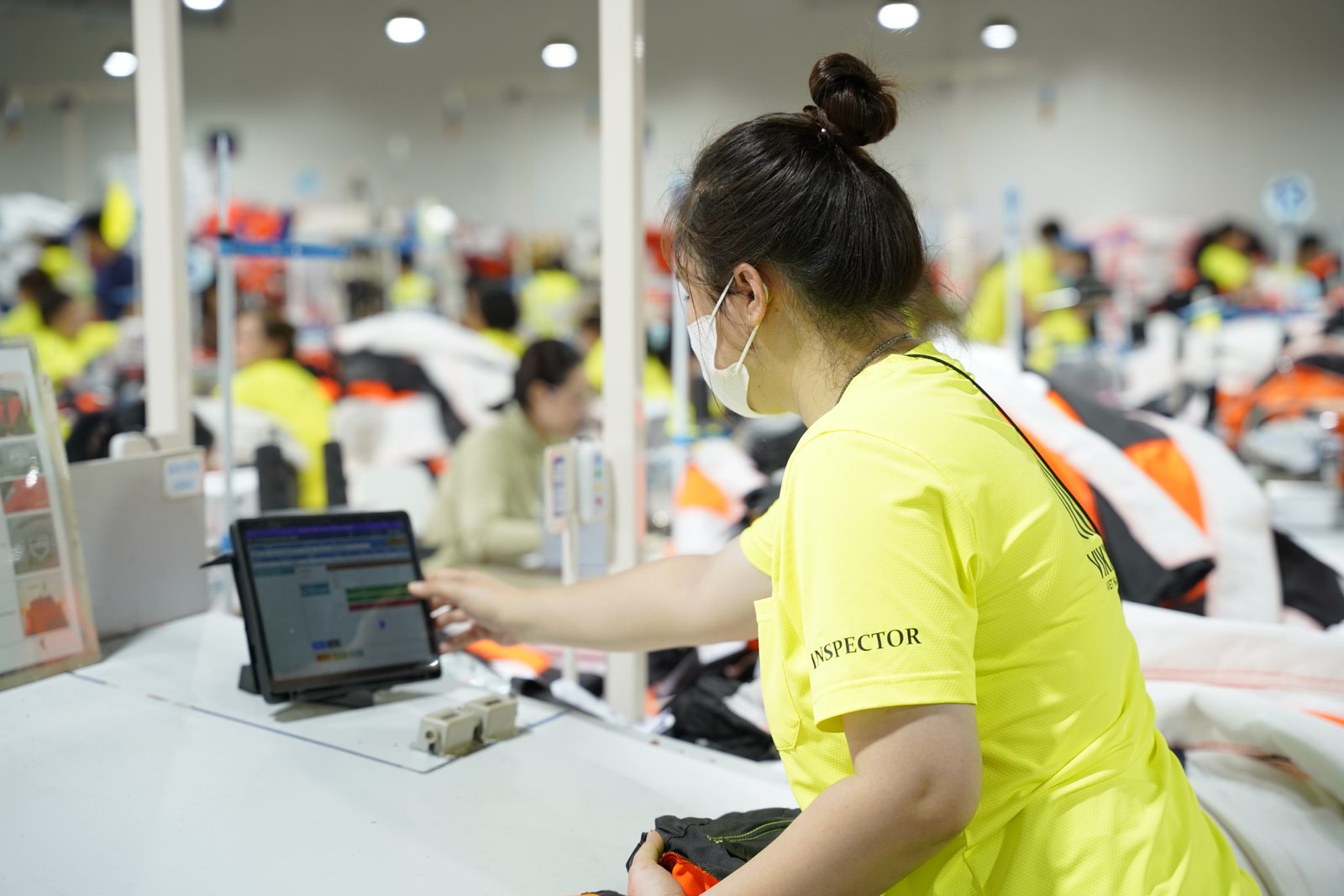
Many factories do this in the wrong order, and pay for it.
While the cause is still being investigated, the factory must immediately answer a different question: is the remaining stock affected?
What has to happen within hours:
- Hold any shipment of the same style still in the warehouse.
- Inspect 100% of stock from the same fabric lot or the same production date, not a sample.
- Identify other orders sharing that fabric lot, those trims, or that line.
- Check the product currently running on the line.
- List every shipment already delivered that could be affected.
That last list is the psychologically hardest part, because it means telling the customer about shipments where they have not yet found anything.
But this is exactly what separates a dependable supplier from one that acts only when caught. The customer will find those shipments sooner or later. Whether the factory spoke first or second determines how they see that factory for years.
5. Root cause: three layers that must all be reached
Most complaint reports stop at the first layer. That is why the same defect returns six months later.
Layer 1: Where did it happen?
Which operation, which line, which shift, which date, who was working. Answering this requires production records kept in sufficient detail. “Line 3, August” is not enough.
Layer 2: Why did it happen?
Equipment, material, method, people or environment. A real example: skipped stitches can come from a worn needle, from a heavier new fabric lot, from altered machine settings, from an operator still learning, or from several of those together.
Layer 3: Why did the system not catch it?
This is the decisive layer. Every defect passes at least one control point before it reaches the container. If it got through, then either:
- That control point does not exist, or
- It exists but does not check this item, or
- It checks it but the standard is unclear, or
- It checks it but the inspector was never trained on this point.
A report that answers only layers 1 and 2 leads to corrective actions of the type “operators reminded, inspection reinforced”. Experienced customers read that sentence and know the factory has found nothing.
6. What the 48-hour report must contain
The report does not need to be long. It needs seven parts:
- Confirmation of the issue: restate what the customer reported, in the customer's own terms.
- Scope: which shipments may be affected, including ones the customer has not identified.
- Re-inspection results: how many checked, how many found, the actual rate.
- Cause: all three layers, or a clear statement of which layer is still under investigation and when it will be resolved.
- Containment actions: what has already been done, not what will be done.
- Corrective actions: what changes in the process, who owns it, by when.
- Proposal for the affected goods: rework, replacement, allowance or another option, with dates.
If the investigation is incomplete after 48 hours, the report still goes out, stating plainly what is missing and when it will be available. Silence because the picture is incomplete is the worst option available.
7. A corrective action is only credible if it can be proven
A corrective action is believable only when it answers the question: how will we know it worked?
Compare two versions:
First version: “A meeting was held with line leaders and operators, inspection has been reinforced.”
Second version: “A seam strength check has been added at the end of the operation, at a frequency of one piece in fifty, recorded on a dedicated form. Effective from a stated date. Data will be sent after three weeks to assess effectiveness.”
The second can be verified. The first cannot.
International customers read a great many corrective action reports each year. They tell the two apart immediately.
8. The mistakes that undo everything
These are the errors seen most often in this industry:
- Blaming the fabric supplier in the first email. Even when true, it reads as avoidance. The factory, not the fabric supplier, holds the contract with the customer.
- Citing “the sample was approved” as an argument. An approved sample does not entitle bulk production to be defective.
- Understating the figure. If the real defect rate is 8% and 3% is reported, the customer will find out when they inspect more. From then on, every other figure the factory reports is doubted.
- Fixing only the shipment under complaint. If the cause remains, the defect returns on the next order, with a different customer.
- Letting the sales team answer alone. Technical content must be written by technical people, even when sales sends it.
- Closing the file as soon as the customer stops asking. A customer who stops asking has not forgotten.
9. What the customer is actually assessing
When a complaint arises, the customer is not only examining the defect. They are answering a much larger question:
“Will this factory tell me the truth when something goes wrong?”
The answer determines whether they will place more important orders, entrust more difficult products, and commit over the long term.
A factory that has never had a defect does not exist. A factory that handles defects transparently and systematically does, and that is what customers are looking for.
10. Questions a buyer should ask before anything goes wrong
The best time to assess a factory's complaint handling is when there is no complaint.
Five questions worth asking at the next factory visit:
- Show me one closed complaint file from the past twelve months.
- From receiving a complaint to issuing the first report, how long does the factory take?
- If I ask about a shipment delivered a year ago, how long until you can tell me the production date and fabric lot?
- Who signs off a corrective action report?
- Has the factory ever reported a defect to a customer before the customer found it?
That last question tells you the most about the factory's culture.
11. Viking Vietnam's approach
Viking Vietnam manufactures high performance apparel, workwear, rainwear, waterproof garments, protective clothing and outdoor apparel for customers in Europe, the United States and Japan.
On these product lines, a defect is not only a cosmetic matter. It can relate to the protective function the wearer depends on. Viking's handling principles are therefore:
- Acknowledge within hours, without waiting for complete conclusions.
- Contain before the investigation is finished.
- Trace by fabric lot and production date, not by memory.
- Work through all three cause layers, including “why did the system not catch it”.
- Report potentially affected shipments proactively, even when unasked.
- Attach a measure of effectiveness and a review date to every corrective action.
Viking does not claim never to produce a defect. What Viking commits to is that the customer learns the truth early, and knows exactly what the factory is doing about it.
Summary of operational value
How a factory handles a complaint says more about it than any certificate.
The points to remember:
- First hour: acknowledge and ask, do not explain.
- Contain first, investigate second.
- Work through all three cause layers, the third being “why did the system not catch it”.
- Report within 48 hours even when incomplete, stating clearly what is still missing.
- A corrective action is credible only when its effect can be measured.
- Proactively flagging shipments the customer has not found is what builds lasting trust.
- Assess a factory's complaint handling while there is no complaint.
Connect with Viking Vietnam
Viking Vietnam works alongside international brands and partners in manufacturing high performance apparel, workwear, rainwear, waterproof garments, protective clothing and outdoor apparel. With lot level traceability, a defined incident process and a transparent way of working, Viking Vietnam is ready to discuss quality control arrangements for your product line.
Contact Viking Vietnam to discuss quality control, traceability and incident handling.