A practical checklist for buyers auditing a garment factory: what to look at in the warehouse, cutting room, sewing line, inspection, seam sealing and packing, plus the signs that cannot be staged.
What to look at beyond the certificate wall.
Almost every factory has a wall of certificates. ISO 9001, ISO 14001, SA8000, third party audit reports. A customer walks in, looks at the wall, and usually feels reassured.
But what does a certificate prove?
It proves the factory met the requirement on the day it was audited. The factory knew that day was coming. The floor was cleaned, the records were prepared, the operators were briefed.
What the customer actually needs to know is how the factory runs on an ordinary day, when nobody is coming to inspect.
That is what decides whether their order will be stable.
This article is for buyers, sourcing managers, product developers, or anyone about to audit a garment factory. It focuses on what to look at, what to ask, and what the answers reveal.
1. Send three questions before you arrive
The audit starts before the customer reaches the gate.
Three questions worth sending in advance:
- Which product group will the factory be running in the week I visit?
- Can I see an order already mid-line, rather than one that starts that morning?
- Can I see the defect records for the last three months?
These are not trick questions. They simply make clear that the customer wants to see real production.
The factory's reply already says a great deal. A well controlled factory answers specifically: which style, which line, which stage. A factory that is not ready answers vaguely, or suggests moving the date.
Neither answer is wrong. But the difference between them is useful information.
2. The certificate wall: read the small print
Certificates still matter. But they have to be read correctly.
Three things to check on each one:
- The validity date. Still valid, or expired.
- The scope. Which activity it covers, at which site. A certificate issued for factory A does not automatically cover workshop B.
- The issuing body. Who performed the audit, and whether that body is accredited.
On protective products, two kinds of document need to be kept apart: the factory's system certificates, and product certification against technical standards such as EN ISO 20471, EN ISO 11612 or EN 343.
One does not substitute for the other. A factory holding ISO 9001 does not mean its products are certified to a protective standard. Equally, a product test report does not prove the factory has a system that holds that quality through bulk.
The question worth asking: which fabric lot does this test report belong to, and how does the factory control the next lot so it matches the one tested?
3. Start at the warehouse, not at the sewing line
Most tours start at the sewing line, because it is the most photogenic and the most active part of the factory.
But quality starts at the warehouse.
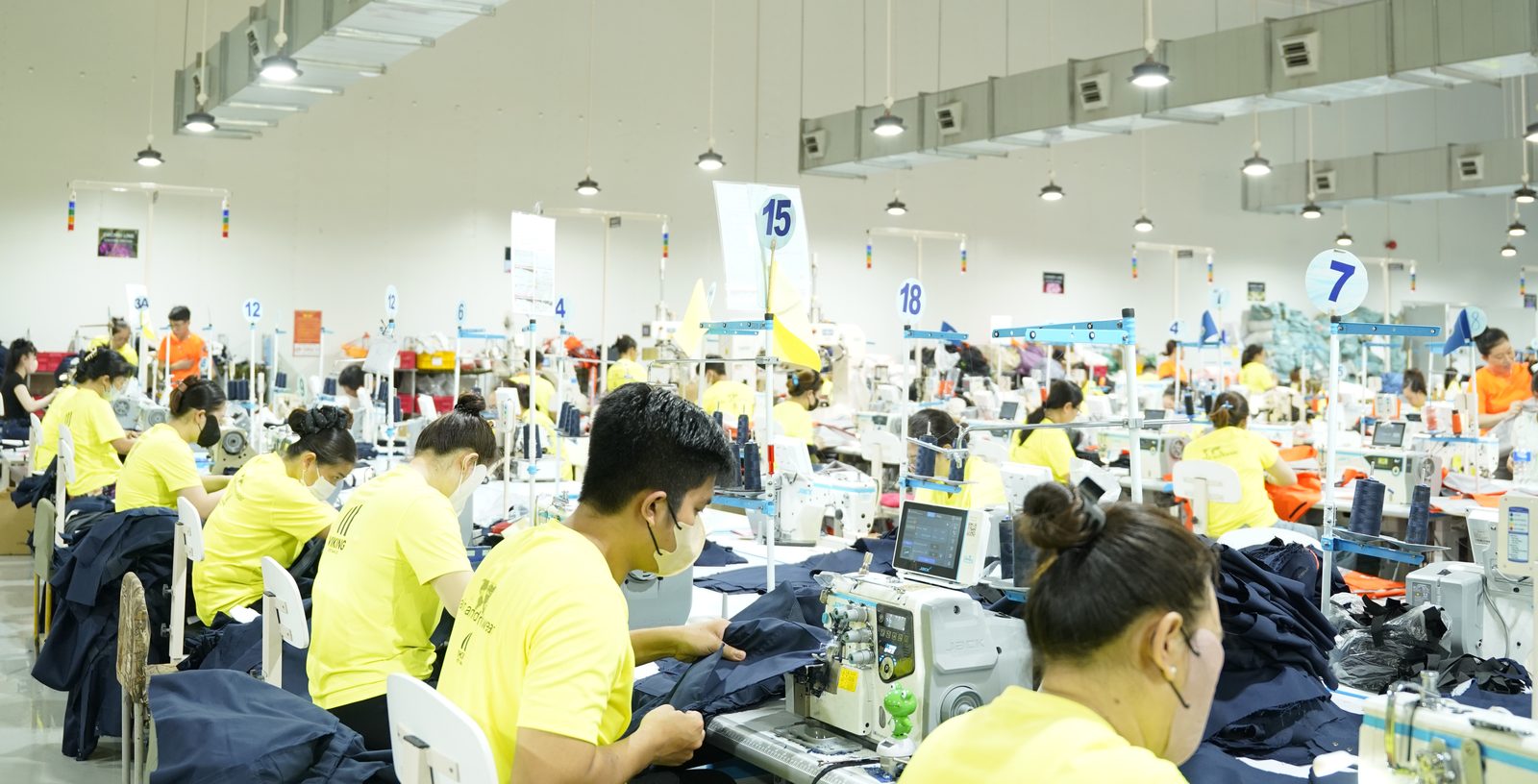
In the material store, look at:
- Whether fabric is arranged by style and by lot, or mixed together.
- Whether there are separate areas for material awaiting inspection, approved material and material on hold.
- How small trims such as zippers, seam tape and reflective tape are stored.
- Whether each roll carries an identification tag, and what the tag says.
- How long the factory takes to find a specific lot when asked.
The most effective question in the warehouse is a simple one: show me the fabric lot being used on the order running out there on the line.
How long the factory takes to answer that tells you whether its traceability is real or only on file.
4. The cutting table: where one defect multiplies fastest
On the sewing line, one defect affects one garment. At the cutting table, one defect affects the whole spread.
Look at:
- Whether the marker is checked before cutting.
- How fabric face and grain direction are controlled.
- Whether cut parts are numbered, bundled and labelled.
- What the bundle ticket records: style, size, colour, lot, spread, date.
- How defective fabric is handled when it appears mid-spread.
If bundles carry no identification ticket, the factory will struggle to trace anything when a problem appears later. It is a small detail, and it reflects how much of the system is actually controlled.
5. The sewing line: watch the rhythm, not the speed
A fast line looks impressive. But speed is not the most reliable indicator.
What is worth watching is the rhythm: whether work flows evenly through the operations or piles up at a few points.
Easy things to observe:
- Where the stack of work in progress is noticeably higher than elsewhere.
- Whether any operator is sitting waiting for work.
- Where repair work is kept, and how large that pile is.
- Who is handling the hardest operation on this style.
- Whether there is an hourly output board, and whether the numbers on it were updated today.
A high stack before one operation is a bottleneck. A bottleneck is not a failing — every line has one. The question is whether the factory knows where it is.
Worth asking the line leader: which operation on this style is the hardest, and how are you handling it?
A specific answer shows the line is being managed with understanding. A vague answer shows the opposite.
6. The inspection table: ask about yesterday's defects
At the inspection table, do not only ask for the defect rate. That figure is easy to prepare in advance.
Ask something more specific:
- What was the most common defect on this line yesterday?
- Which operation did it come from?
- Who was told, and when?
- What was done so it would not repeat today?
- Was there a similar defect last week?
A real quality system answers that chain of questions in a few minutes, because the information is part of daily work.
A system that exists only on paper will have to go and find the records.
The most telling detail is not whether the defect rate is low or high, but whether the factory classifies defects by cause or only counts them. Classifying by cause shows a factory that is improving. Counting shows a factory that is reporting.
7. The pilot piece and the change record
These two records tell you more than most other documents.
On the pilot piece, ask:
- Who approves it.
- Against which check points.
- Whether the pilot piece for the running style is still kept at the line.
- Whether the line is allowed to continue if the pilot piece fails.
On the change record, ask:
- When a customer last changed a requirement mid-order.
- Where that change was recorded.
- Which departments were informed, and how.
- How goods produced before the change were handled.
Change control is where many factories show their weakness, because it requires several departments to update the same information quickly. A factory that answers this clearly usually controls the rest well.
8. Seam sealing and testing, on waterproof products
If the order is a waterproof product, this is where the time is best spent.
Look at:
- Whether the sealing machines allow temperature, pressure and speed to be adjusted.
- Where the sealing parameters for the running style are recorded.
- Who is allowed to change them.
- How the sealed seam is checked after sealing.
- Whether the factory has a water pressure test area, and how often it tests.
- Where a garment goes when a sealed seam fails.
The most important question: was the seam tape in use tested with this actual fabric lot before production started?
Tape and fabric have to be compatible. A factory that understands this answers immediately.
9. Finishing and packing
This area is often skipped on a tour, and yet it generates more practical problems on export orders than almost anywhere else.
Look at:
- Whether goods from different styles are clearly separated.
- How labels, tags and care instructions are controlled.
- Who checks the packing list before the carton is closed.
- Where goods on hold are kept, and whether they are marked.
- Whether the area has enough light to inspect properly.
A garment sewn correctly but labelled wrongly is still a problem shipment. For European, U.S. and Japanese markets, a labelling error can hold a whole consignment at port.
10. Ask an operator, not only a manager
Many customers hesitate to do this, and it usually gives the most honest information.
Nothing complicated is needed. Three questions are enough:
- How long have you been doing this operation?
- Which part is hardest?
- When you see a problem with the garment, who do you tell?
The third question is the important one.
If the operator answers at once, names a specific person and can describe what happens next, the feedback system is real. If the operator hesitates or looks towards a manager, that is an answer too.
This detail cannot be staged, because it reflects a daily habit rather than a written procedure.
11. The signs that cannot be staged
A factory can clean the floor, paint the lines, print the boards and prepare the records before a visit. But some things cannot be prepared in a week.
The most reliable signs:
- Habits, not slogans. Operators checking their own work before passing it on, with nobody reminding them.
- Old data. Tracking boards carrying figures from several weeks back, not only from this week.
- Length of service. Many operators who have been there more than five years. Retention is hard to fake.
- Managers who know operators by name. A small detail that says a lot about how the place runs.
- A factory willing to say no. A factory that accepts every requirement, every deadline and every quantity will run into trouble somewhere.
- A defect record that is not flawless. A record with no defects at all is more suspect than one that records defects with corrective action.
12. Questions worth asking before you leave
Before finishing, it is worth spending ten minutes on questions about how the factory works, rather than what it can produce:
- When the factory finds a risk to the delivery date, when does it tell the customer?
- Who will work with us directly, and where do they sit in the factory?
- If we ask for a technical change mid-order, what is the process?
- What caused the most recent late order, and what changed afterwards?
- Has the factory ever turned an order down, and why?
The last two usually give the most. A factory willing to talk about an order that went badly, and able to say what it changed afterwards, is usually more dependable than one that says everything always goes smoothly.
13. Viking Vietnam and how we approach factory audits
Viking Vietnam manufactures high performance apparel, workwear, rainwear, waterproof garments, protective clothing and outdoor apparel for international customers.
On factory audits, Viking's approach is:
- Showing customers an order already mid-line, not only the display area.
- Opening the defect and corrective action records, including issues not yet closed.
- Letting customers speak directly with line leaders, QC and technical.
- Explaining clearly the scope of each certificate and each test report.
- Saying plainly what the factory does well and what it is still improving.
A valuable audit is not one where the factory looks perfect. It is one where the customer leaves with an accurate picture of where the factory stands, and both sides know what comes next.
Summary of operational value
An effective factory audit looks beyond the certificate wall.
Where to concentrate:
- How the factory responds to three questions sent before the visit.
- The validity, scope and issuing body of each certificate.
- How the warehouse manages fabric lots, and how fast it can trace one.
- Identification tickets on bundles after cutting.
- Line rhythm and where the bottleneck sits, rather than line speed.
- Yesterday's defects and what was done about them.
- The pilot piece record and the change control record.
- Seam sealing parameters and how sealed seams are checked.
- What an operator says when asked who they report a problem to.
- The signs that cannot be staged: retention, old data, self checking habits.
Connect with Viking Vietnam
Viking Vietnam works alongside international brands and partners in manufacturing high performance apparel, workwear, rainwear, waterproof garments, protective clothing and outdoor apparel. With a quality system, technical capability and a transparent approach to cooperation, Viking Vietnam welcomes factory audits from international customers.
Contact Viking Vietnam to arrange a factory visit, or to discuss the technical requirements of your product line.