A delivery date is counted backwards from the vessel date to sample confirmation. This article sets out the two decisive links, where time disappears from the plan, and the questions that reveal whether a date is grounded.
When a factory says “yes, we can make that date”, the answer comes either from a backward calculation or from a wish to please. Those two produce very different results.
In every discussion between an international buyer and a garment factory, one question arrives earlier than price: how soon can you deliver?
And very often the answer comes within seconds.
That is the problem.
A dependable delivery date is not the number the seller wants to give or the buyer wants to hear. It is the result of counting backwards from the vessel date to the fabric order date, where every step carries real time and real risk.
This article sets out that calculation, so a buyer can tell whether they are hearing a grounded number or a promise.
1. A delivery date is calculated backwards, not forwards
The instinct is to count forwards: order today, add production time, arrive at a date.
Experienced factories do the opposite. They start from the date the goods must be on the vessel and work back:
- The date the goods must reach the port.
- The date packing and final inspection must be complete.
- The date the last piece leaves the line.
- The date the line starts this style.
- The date cutting must be finished.
- The date all fabric and trims must be in the warehouse and inspected.
- The date fabric and trims must be ordered.
- The date the sample and all specifications must be confirmed.
Counted this way, one thing becomes immediately clear: the delivery date is mostly not determined by sewing speed.
It is determined by two things at opposite ends: when the sample is confirmed, and how long the fabric takes.
2. The two decisive links, which the buyer controls more than the factory does
First link: the date the sample and specifications are confirmed.
Until the sample is approved and the specifications are frozen, the factory cannot order the right fabric quantity, cannot make the cutting marker, and cannot calculate consumption accurately.
Every week lost here pushes the delivery date out by exactly one week. Nothing in the sewing stage recovers it, because sewing is not the bottleneck.
Second link: fabric and trim arrival.
On technical products, fabric is usually not on the shelf. Multi layer laminates, coated fabrics, and fabrics with water repellency or flame resistance requirements are generally woven and finished to order. That duration is set by the fabric supplier, not by the garment factory.
Functional trims, waterproof zippers, seam sealing tape, reflective tape, specialised fastenings, are often slower than the fabric.
An honest factory will say plainly: “The delivery date depends on the fabric arrival date, and this is the date our supplier has confirmed.” A factory determined to close the order at any cost will simply give a number.
3. Sewing time is only one part, and it is less elastic than people assume
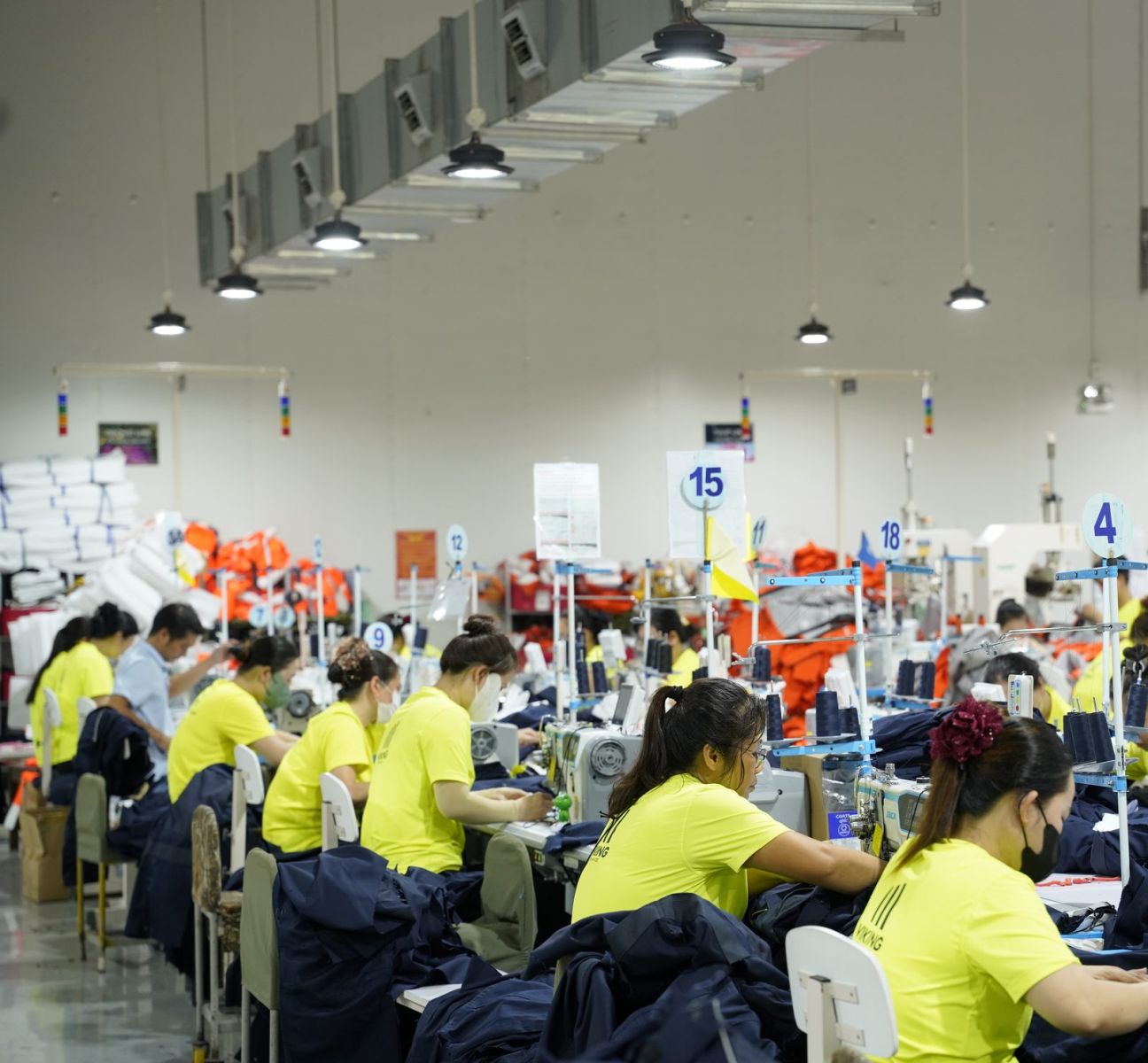
A common assumption is that if the order is urgent, the factory can simply add overtime or add lines.
In practice it does not work that way, for three reasons.
First, a line needs time to stabilise. When a new style starts, output in the first days is significantly lower than once the line knows the product. On technical products with many components, that period is longer. Splitting across several lines means paying that cost several times.
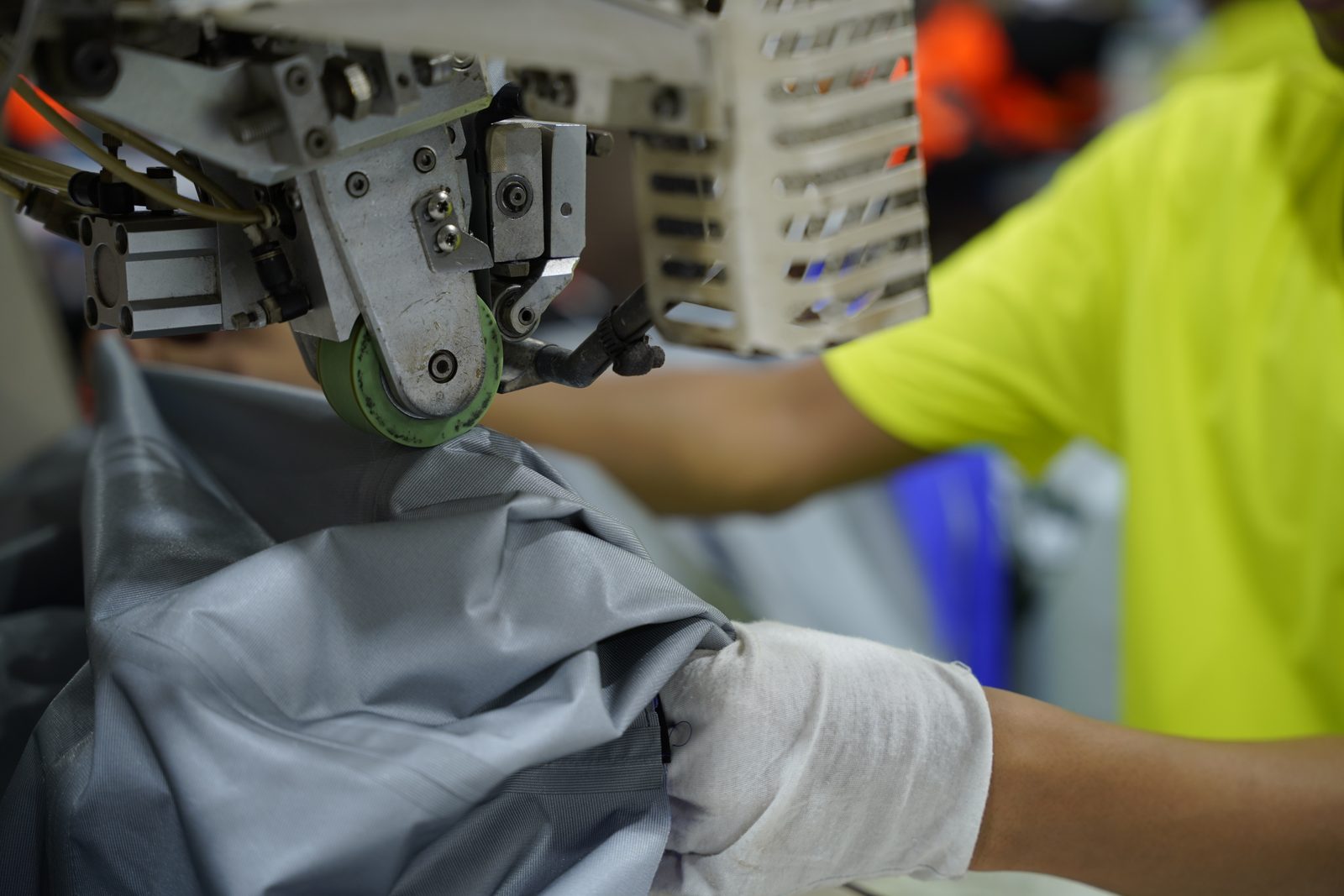
Second, some operations cannot be doubled by adding people. Seam sealing, bonding, embroidery, printing, anything requiring specialised machines, the number of machines is a hard limit. More operators do not make a machine run faster.
Third, sustained overtime raises the defect rate. Anyone with long experience in production knows this. Saving two days through overtime and then losing five days to rework is a losing calculation.
4. Where time disappears without appearing in the plan
Production plans on paper are usually correct. Reality diverges because of gaps nobody scheduled:
- Waiting for approval of the first line sample. The line is ready but must stop while the customer confirms the first piece.
- Waiting for confirmation of a small change. A question sent Friday afternoon and answered Tuesday morning costs two and a half days.
- Fabric arrives in full quantity but with shade variation between lots. Lots must be separated, markers redone, and sometimes the customer re-consulted.
- Incoming fabric inspection finds a fault. Waiting for the supplier to replace it was not in the original plan.
- Trims arrive after the fabric. Garments sewn but unlabelled for the correct market still cannot ship.
- Third party inspection scheduling. Independent inspection bodies have their own calendar and do not always come on the day the factory wants.
- Holidays at both ends. Tet in Vietnam, summer shutdowns in Europe, Obon in Japan, each can shift a plan by one to three weeks if not allowed for.
A factory that plans seriously builds buffer for these. A factory giving the most attractive possible number does not.
5. A capacity commitment is not a delivery commitment
This is where the two sides most often misunderstand each other.
When a factory says “we can make this product”, that is a statement about technical capability and capacity.
When a factory says “we will deliver on that date”, that is a statement about free space in the plan at a specific moment.
These are not the same. A fully capable factory can still miss a date if that window is already booked.
So the buyer's right question is not “can you make it?” but:
“In that week, which line will run our goods, and what is on that line now?”
The answer tells you more than any assurance.
6. Why factories should say “no” more often
This part is said plainly, because it is a real problem in the industry.
Pressure to win orders leads many factories to accept dates they know are difficult. The thinking is usually: take it now, work it out later.
The cost of that thinking is concrete:
- Sustained overtime, tired operators, rising defect rates.
- Goods shipped by air instead of sea, with freight costs consuming the margin.
- Another customer's order pushed back to rescue this one.
- Trust lost, so that next time the customer discounts every figure the factory gives.
By contrast, a factory that says “we cannot make that date, but this one is certain” often loses the order and keeps the customer.
In this industry, a factory able to say “no” is a factory whose “yes” is worth something.
7. What the buyer can do to avoid delaying their own order
A significant share of late shipments begins on the buyer's side, usually unintentionally.
What shortens lead time most:
- Confirm the sample properly, not as “close enough, we will adjust later”. Every change after the fabric is ordered costs several times more time.
- Answer technical questions within 24 hours. This is the cheapest and most effective lever a buyer has.
- Confirm the size breakdown early. The cutting marker depends on the size ratio; changing it after cutting means starting again.
- Agree the inspection standard at the start of the season, not when the goods are finished.
- Give advance notice of holidays and third party inspection dates.
- If the order date slips, ask for a revised delivery date rather than assuming it is unchanged.
8. Questions that reveal whether a date is grounded
When a factory gives a delivery date, these six questions show whether it was calculated or guessed:
- What date was this counted back from?
- What is the expected fabric arrival date, and has the supplier confirmed it?
- What is the latest date we must confirm the sample to hold this delivery?
- How many buffer days are in the plan, and where do they sit?
- Which line will run this order, and what else is on that line that week?
- If the fabric arrives one week late, what does the delivery date become?
The last question is the most useful. A factory that answers it immediately has a real plan. A factory that says “we will do our best” has not done the calculation.
9. How Viking Vietnam handles delivery dates
Viking Vietnam manufactures high performance apparel, workwear, rainwear, waterproof garments, protective clothing and outdoor apparel for customers in Europe, the United States and Japan.
Production time differs for every order, because it depends on product complexity, the fabric and trims involved, quantity, and the time of year. Viking therefore does not publish a single lead time for all orders.
Instead, the working method is:
- Count backwards from the vessel date, not forwards from the order date.
- State the latest date the customer must confirm the sample and specifications to hold the delivery.
- State the date fabric and trims must reach the warehouse, with the supplier's confirmation status.
- Show where the buffer sits, rather than hiding it inside a total.
- Flag a delayed link early, rather than when it can no longer be recovered.
- Decline a date without a basis, and propose one that has a basis.
Specific lead times for each product line are confirmed order by order, once fabric, trims and line scheduling are clear.
Summary of operational value
A dependable delivery date is the result of a backward calculation, not a comfortable number.
The points to remember:
- The date is counted backwards from the vessel date through every milestone to sample confirmation.
- The two decisive links are sample confirmation and fabric arrival, both largely outside the sewing stage.
- Sewing time is not freely elastic: lines need to stabilise, specialised machines are a hard limit, and sustained overtime raises defects.
- A capacity commitment is not a delivery commitment; the right question is about free space in the line schedule.
- Buyers shorten lead time most by confirming samples properly and answering technical questions within 24 hours.
- A factory willing to say “no” is a factory whose “yes” can be trusted.
Connect with Viking Vietnam
Viking Vietnam works alongside international brands and partners in manufacturing high performance apparel, workwear, rainwear, waterproof garments, protective clothing and outdoor apparel. With transparent planning and straightforward discussion of timing, Viking Vietnam is ready to build a workable production schedule with customers each season.
Contact Viking Vietnam to discuss production planning and delivery timing for your product line.