Explore how ISO 14001 supports environmental management in export garment manufacturing, helping factories control materials, energy, waste, chemicals, and sustainable improvement.
In export garment manufacturing, sustainability is no longer a fine slogan in a company profile. For international customers, especially in Europe, the United States and Japan, a dependable garment factory has to show how it controls environmental impact in daily operations.
Environmental impact in a garment factory does not come from a single point. It can arise from material use, electricity, water, compressed air, heat, packaging, chemicals, fabric waste, dust, production waste, and even from how the factory handles defects and rework.
This is why ISO 14001 matters in modern garment manufacturing. According to ISO, ISO 14001 is the internationally recognised standard for environmental management systems, providing a framework for an organisation to establish, implement and improve a system that enhances environmental performance, reduces its environmental footprint, meets applicable legal requirements and achieves environmental objectives.
For Viking Vietnam, the spirit of ISO 14001 is not simply meeting audit requirements. What matters more is how the factory turns environmental responsibility into concrete processes, habits and operating data.
Environmental management starts with a whole system view
A garment factory cannot manage the environment through isolated activities alone, such as planting trees, sorting waste or saving electricity. Those activities are necessary, but without a clear management system behind them they rarely create lasting impact.
ISO 14001 helps the factory see the environment as a system. That means identifying the environmental aspects of its activities, assessing the level of impact, setting objectives, carrying out actions, tracking results and improving continually.
In garment manufacturing, this way of looking at it leads to practical questions:
- Which operation generates the most waste?
- Which area consumes the most electricity?
- Which packaging could be optimised?
- Which chemicals or auxiliary supplies need tight control?
- Which production defects are increasing repair work, rejects or material consumption?
- How can waste be reduced at cutting, sewing, seam sealing, finishing and packing?
When the environment is managed as part of the operating system, the factory does not only look green on the surface; it begins optimising from inside the process.
Controlling materials is the first step of sustainable manufacturing
In the apparel industry, materials are one of the largest sources of environmental impact. Every metre of defective fabric, every wrongly cut piece, every trim used by mistake can waste resources, time, energy and labour.
Environmental management therefore cannot be separated from quality management.
At a technical garment factory like Viking Vietnam, controlling materials has to begin with very concrete steps:
- Checking material information before production.
- Managing fabric lots, colours, style codes and trims.
- Using a sensible marker to reduce wastage.
- Controlling fabric defects to avoid rejects.
- Sorting and handling fabric waste correctly.
- Tracking material utilisation and the causes of waste.
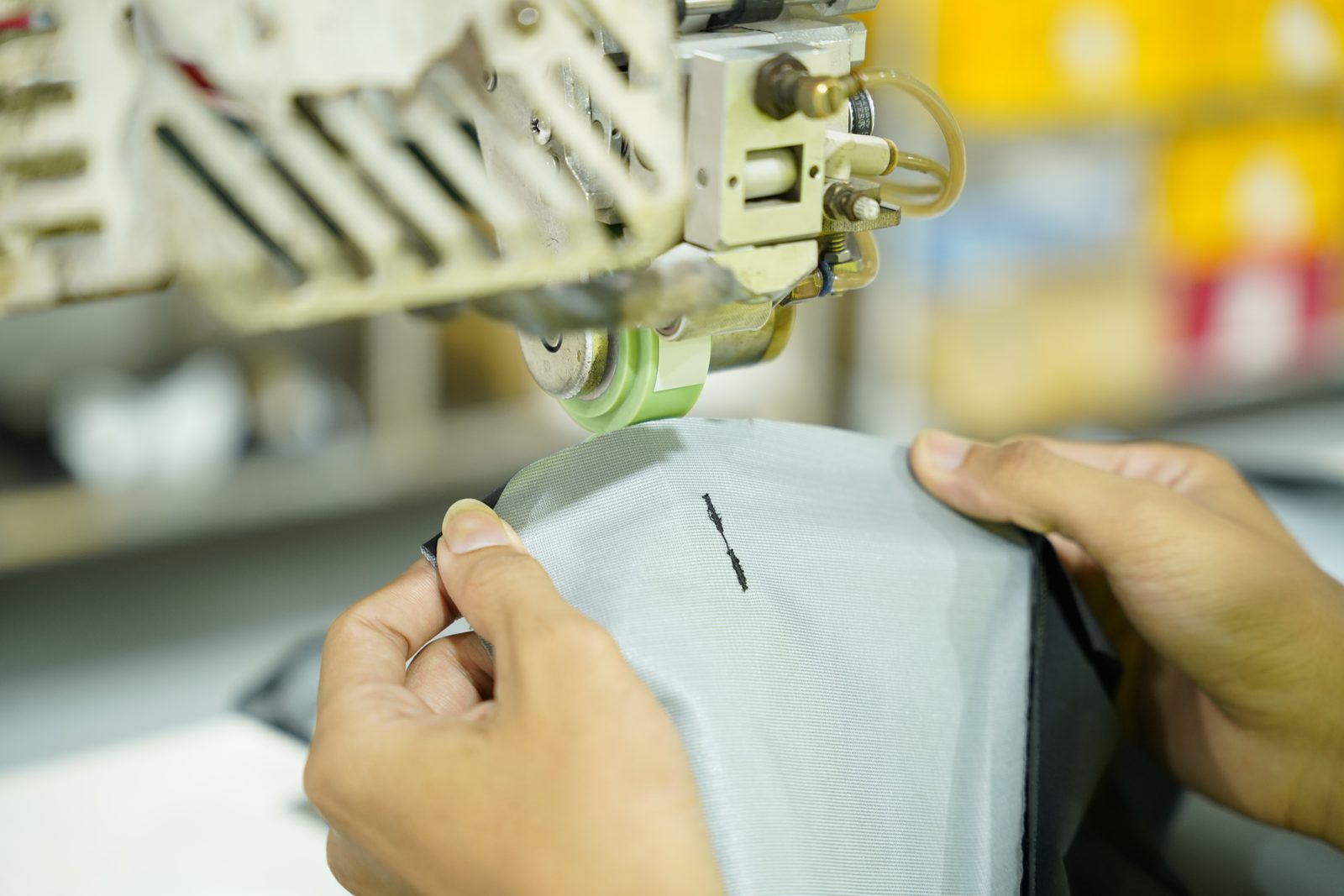
On high performance apparel, workwear, waterproof garments or protective clothing, materials usually carry higher technical requirements. A material fault or a handling error therefore does not only waste resources; it can affect how the product performs.
Getting it right the first time is one of the most practical ways to manufacture sustainably.
Energy and equipment have to be managed through operating habits
A garment factory runs a great deal of equipment: sewing machines, cutting machines, pressing machines, air compressors, lighting, ventilation, cooling, irons, finishing equipment and many specialised machines. Without good management habits, energy can be wasted in every shift.
Environmental management in the spirit of ISO 14001 brings energy use into daily control.
The activities can include:
- Switching equipment off when it is not in use.
- Maintaining machines to reduce abnormal consumption.
- Tracking the areas with high electricity use.
- Optimising lighting and ventilation.
- Checking for compressed air leaks where relevant.
- Training staff to recognise energy saving habits.
- Assigning responsibility for equipment use to each operating area.
The important point is that saving energy should not be a slogan. It has to become behaviour the team repeats every day.
When operators, line leaders, maintenance and management all understand their part, energy control becomes real rather than theoretical.
Waste management has to be clear at the point where waste is created
In a garment factory, waste can come from many areas: the cutting room, the sewing lines, the material warehouse, finishing, packing, the offices, the canteen and the maintenance area.
If waste is only handled at the end of the process, the factory will struggle to find the root cause. Effective waste management therefore has to start where the waste is created.
The important questions are:
- Which area does the waste come from?
- What type of waste is it?
- Can it be reduced at source?
- Can it be reused, recycled or sorted better?
- Does any of it need a separate handling procedure?
- Who is responsible for controlling that area?
- Is waste data recorded and tracked?
In apparel, fabric waste and packaging are two groups that need constant attention. Supplies related to chemicals, adhesives, inks, machine oil or maintenance also need to be controlled under the appropriate rules.
A good system does not only ask whether the waste has been cleared. It asks the deeper question: why is there so much of it, and how can it be reduced at source?
Chemicals and auxiliary supplies need responsible control
In technical garment manufacturing, some operations use auxiliary supplies, adhesives, treatment chemicals, cleaning agents, machine oil or maintenance products. Poorly controlled, these can create risk for the environment, for workers and for product quality.
Responsible chemical management needs to include:
- Identifying which chemicals or supplies need control.
- Storing them in the right area and the right conditions.
- Clear identification labels.
- Safe use instructions.
- Training for the people who handle them directly.
- Controlling stock levels and consumption.
- Handling related packaging or waste through the correct procedure.
- Having a response plan in case of an incident.
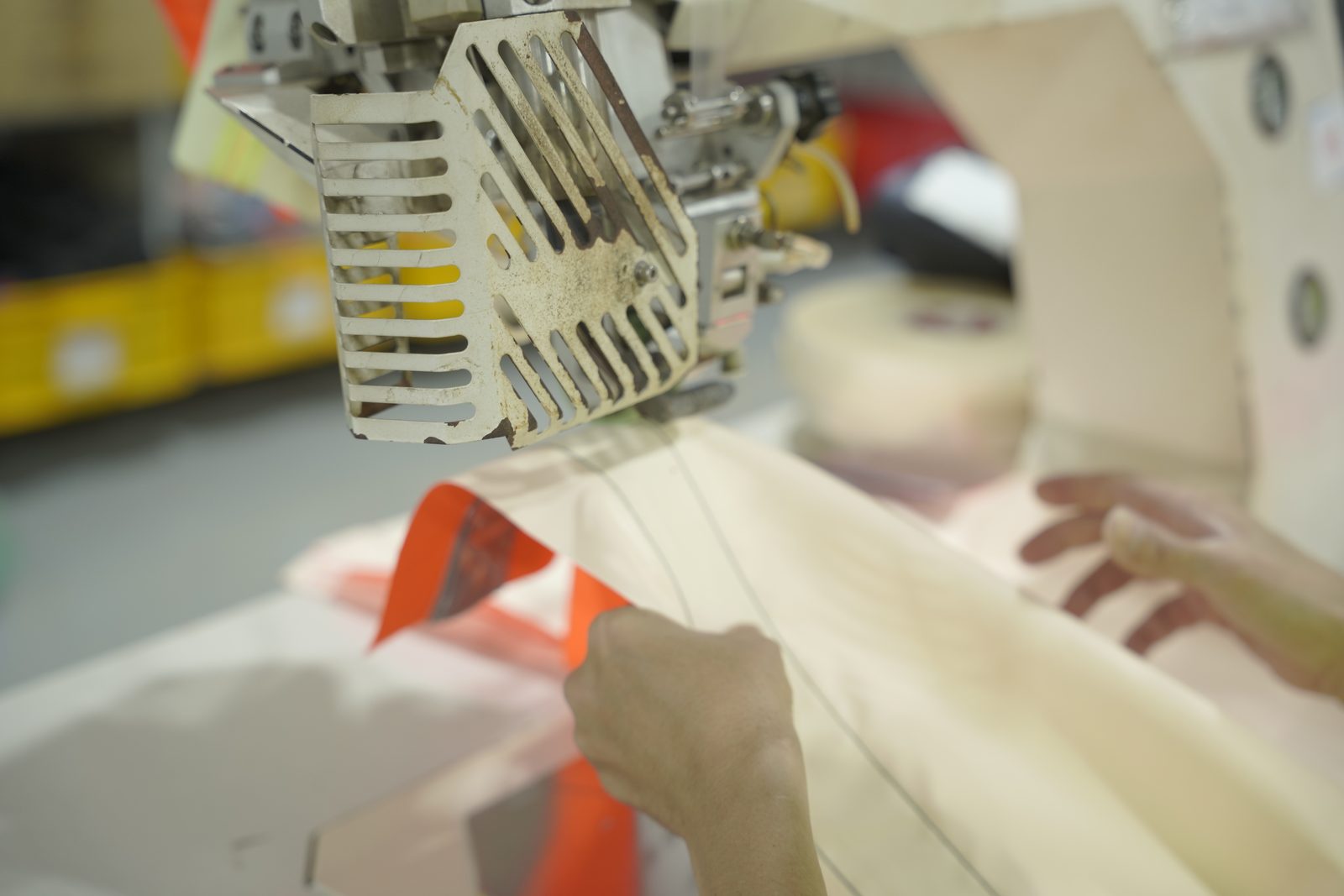
For international customers, the control of chemicals and auxiliary supplies is an important part of factory assessment. It shows that the factory cares not only about the product it ships, but about how that product is made.
ISO 14001 connects the environment to continual improvement
A sound environmental management system does not stop at compliance. It has to produce continual improvement. The United States Environmental Protection Agency describes an environmental management system under ISO 14001 as operating on a repeating cycle, usually associated with the Plan, Do, Check, Act method.
In a garment factory, this can be understood very simply:
- Plan: identify the environmental issue and set an improvement objective.
- Do: carry out the actions in the departments involved.
- Check: measure, verify and record the results.
- Act: adjust, standardise and keep improving.
For example, if fabric waste at the cutting table rises, the factory should not simply record the number. It needs to analyse the cause: a marker that is not optimised, a high level of fabric defects, a late technical change, cutting errors, or unclear size and colour information. The departments involved then need to agree on improvement actions together.
This is exactly where the environment, quality and production efficiency meet.
People are the decisive factor in environmental management
No environmental system works if the people operating it do not understand it and do not take part.
In a garment factory, everyone can affect the environment through daily actions: how they use electricity, how they sort waste, how they store materials, how they handle defects, how they use machines, how they save trims and how they report problems.
Training and internal communication are therefore an important part of ISO 14001. Workers need to understand that protecting the environment is not the job of the administration department, the ISO office or the management board alone. It is a shared responsibility in every position.
An operator who spots faulty material early can reduce rejects. A line leader who reminds the team to switch equipment off can reduce energy consumption. A warehouse staff member who manages fabric lots well can reduce the risk of using the wrong material. A maintenance technician who services a machine on time can reduce wasted electricity and reduce interruption to production.
When the environment becomes a shared awareness, the system truly lives inside the factory.
The value for international customers
For international brands and partners, choosing a factory is not based on price, capacity or lead time alone. More and more customers care about how the factory manages environmental impact, social responsibility and supply chain risk.
ISO states that ISO 14001 belongs to the ISO 14000 family of environmental management standards and is the standard that sets the criteria for an environmental management system. This creates a common language in which customer and factory can discuss objectives, processes, evidence and environmental improvement.
For the customer, a factory with a sound environmental management system brings real value:
- Lower compliance risk in the supply chain.
- Greater transparency in the production process.
- Support for the brand's ESG requirements.
- Less waste and better operating efficiency.
- A foundation for long term partnership.
- More confidence when developing sustainable product lines.
For Viking Vietnam, environmental management is part of competitive capability. A high quality product needs to be made inside a responsible system.
Viking Vietnam and the direction of sustainable manufacturing
Viking Vietnam develops manufacturing capability in high performance apparel, workwear, rainwear, protective garments and outdoor apparel for international customers. These product lines usually carry higher technical requirements, longer service life and a need for consistency at every operation.
In its operating direction, Viking Vietnam focuses on connecting quality, people, the environment and production efficiency. That shows in how the factory controls materials and trims, prepares production, monitors the process, trains its team, manages waste and improves each working area.
Sustainable manufacturing is not one big activity on one day. It is how a factory keeps doing the right things across many days, many orders and many production seasons.
For Viking Vietnam, ISO 14001 is the framework that systematises those efforts, so that environmental responsibility does not stay in a commitment but enters real operations.
Summary of operational value
ISO 14001 in a garment factory is not only an environmental standard. It is how the factory builds a system to identify, control and improve environmental impact across the whole of production.
An effective environmental management system helps the factory:
- Control materials and reduce waste.
- Manage energy, equipment and operating habits.
- Sort, track and reduce waste at source.
- Control chemicals and auxiliary supplies responsibly.
- Link the environment to quality and continual improvement.
- Increase transparency with international customers.
- Strengthen the foundation for ESG and sustainable manufacturing.
Connect with Viking Vietnam
Viking Vietnam works alongside international brands and partners in manufacturing high performance apparel, workwear, rainwear, outdoor apparel and other technical product lines. With a systematic approach to environmental management, ESG responsibility and a mindset of continual improvement, Viking Vietnam aims to be a dependable manufacturing partner for customers who need quality, transparency and sustainable development.
Contact Viking Vietnam to develop technical apparel made inside a production system that is responsible towards people, the environment and the global supply chain.