International customers look less at how many sewing lines a factory has than at whether it can control production consistently. This article walks through twelve roles of IE at Viking Vietnam, from the sewing process and machine requirements to line layout, productivity monitoring and line balancing.
In export garment manufacturing, international customers are not only interested in how many sewing lines a factory has, how many operators it employs, or how many machines it owns. What matters more is whether the factory is able to control production in a stable way.
A product can be developed very well at the sample stage, but when it moves into bulk production, many risks can appear:
- Operations are not clearly analysed
- The sewing line becomes unbalanced
- Machines are not prepared appropriately
- The layout is not optimised
- Actual productivity differs from the plan
- Some operations become bottlenecks without being detected early
- Production data is not clear enough to support improvement
This is why the role of IE becomes very important in a technical garment factory.
At Viking Vietnam, IE is not only a department that produces tables or measures operation times. IE is part of the production operating system, turning the technical requirements of a product into a clear production process with data, a layout, a machine plan, and a basis for controlling productivity.
For customers, the presence of an effective IE system builds confidence that the product is not sewn from experience alone, but implemented through a controlled method.
1. IE brings a product from sample to bulk production
In garment manufacturing, a good sample is not enough to guarantee successful bulk production.
When a product moves from the sample stage into production, the factory needs to answer several important questions:
- Which operations make up the product?
- What is the assembly sequence?
- Which operations require special machines?
- Which operations require jigs, attachments or supporting equipment?
- Which operations carry a higher risk of delay or defect?
- What level of skill is required at each position?
- How should the sewing line be arranged so the production flow is logical?
IE is the function that supports the analysis of these points before and during production implementation.
At Viking Vietnam, IE works together with the technical team, the line leader, maintenance, QC and production management so that the sewing process is understood correctly, allocated correctly, and implemented in a way that suits the real conditions of the line.
This reduces risk when a product goes into bulk production, especially for technical ranges such as workwear, protective clothing, waterproof garments, outdoor apparel, or products with many functional details.
2. IE builds a clear sewing process for each product
The sewing process is one of the foundation documents in production.
A clear sewing process allows the factory to define:
- The operations in assembly order
- The expected time for each operation
- The type of machine required
- The appropriate skill level
- Operations that need technical attention
- Control points that may affect quality
- A basis for costing operations and organising production
For customers, a clear sewing process reduces risk in bulk production. When each operation is analysed in advance, the factory can prepare the right resources, equipment and people proactively.
At Viking Vietnam, IE does not write the process on paper alone. IE needs to understand the product, understand the reality of the sewing line, and coordinate with the related departments so the process can actually be applied in production.
A good process does not only describe how to do the work. It helps the line do it correctly, do it consistently, and have a basis for improvement.
3. IE plans machine requirements so the line is better prepared
Machines are an important part of garment manufacturing. However, machines only create value when they are prepared in the right type, the right quantity and at the right time.
For each order, IE coordinates to determine the machine and equipment requirements.
The factors to be considered include:
- The type of machine needed for each operation
- The number of machines required
- Special machines if the product has particular details
- Jigs, templates or attachments that support the operation
- The capacity of the existing machine pool
- The preparation time before the style reaches the line
- The need to coordinate with the maintenance team
Planning machine requirements helps the line avoid missing equipment, late preparation, or reactive adjustment once production has already started.
For technical products, machine preparation matters even more. A different material, a different functional detail, or a complex operation may require specific equipment and operating settings.
When IE coordinates well with maintenance and the technical team, the factory can reduce waiting time, limit interruption, and create the conditions for the line to run more steadily.
4. IE designs the line layout to optimise production flow
Line layout is not only about where machines are placed on the floor. Layout is how the production flow is organised.
An effective layout helps to:
- Reduce the movement time of work in progress
- Reduce congestion between operations
- Let the line leader observe and coordinate more easily
- Let QC reach the important control points
- Let maintenance support the machines more conveniently
- Let operators work to a steadier rhythm
At Viking Vietnam, IE builds the layout from the sewing process, the number of operators, their skills, the machine types, the space available on the line, and the characteristics of each style.
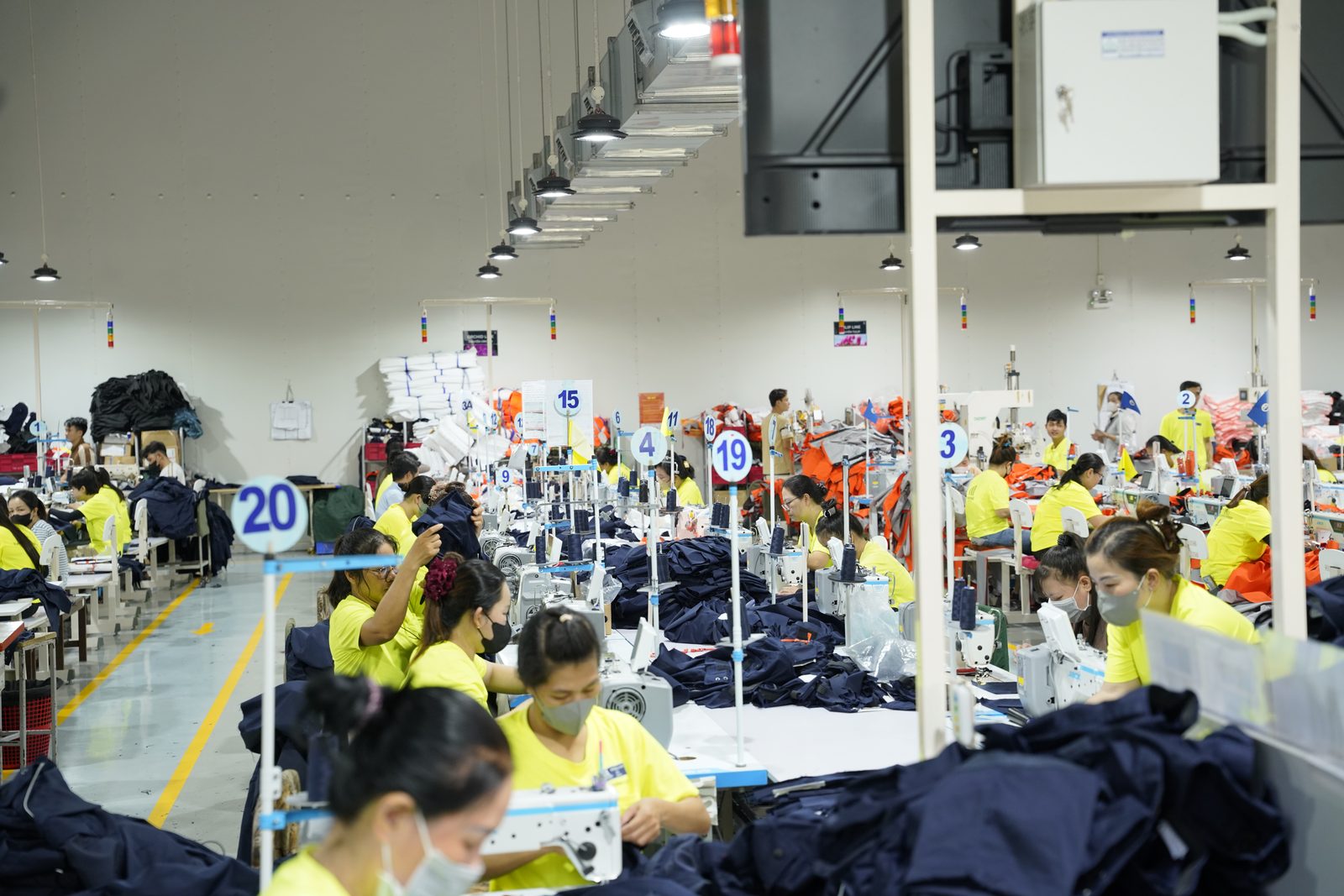
For customers, a good layout increases the ability to control production. When the flow inside the line is organised sensibly, the risk of delay, mixed work in progress, or unbalanced operations can be reduced.
A capable factory does not only need to be able to make the product. It needs to know how to organise production so that the product is made consistently, under control, and repeatably across many orders.
5. IE monitors productivity to detect bottlenecks early
In production, productivity should not be looked at only at the end of the day. If the line only discovers at the end of the day that it has missed the target, the factory has already lost the chance to adjust early.
IE helps monitor productivity by operation group, by operator, or at key points during the day.
Productivity data helps the factory answer questions such as:
- Which operation is running slower than planned?
- Which group is creating the bottleneck?
- Which operator needs additional support?
- Does the problem come from the machine, the method, or the operation allocation?
- Does the line need an adjustment in people or layout?
- Is the target for the day still achievable?
When data is updated in time, the line leader and production management can make decisions faster.
For customers, this creates reassurance, because the factory does not wait for a problem to become serious before dealing with it. The factory has a mechanism to monitor, detect and adjust during production.
6. IE supports line balancing to maintain stable efficiency
An unbalanced line is one of the most common causes of reduced production efficiency.
Some operations may be overloaded while other positions wait for work. This reduces overall productivity, creates uneven pressure on operators, and can affect quality.
IE supports line balancing by analysing:
- The time of each operation
- The number of operators at each position
- The skill suited to each operation
- Actual productivity by group
- The operations creating bottlenecks
- The possibility of splitting or combining operations
- How the layout or the people should be adjusted
Line balancing does not serve output alone. More importantly, it helps the line run steadily, reduces waiting, reduces local pressure, and creates the conditions for quality to be better controlled.
At Viking Vietnam, IE works with the line leader and production management to monitor, analyse and adjust when needed. This is an important part of the factory's operating capability.
7. IE turns production data into a basis for improvement
A factory that wants to improve needs data. But data only has value when it is recorded correctly, analysed correctly, and turned into specific action.
IE contributes to building production data through:
- Operation breakdowns
- Operation times
- Machine requirements
- Line layout
- Productivity by operation
- Implementation tracking sheets
- Line balancing data
- An operation library and method videos
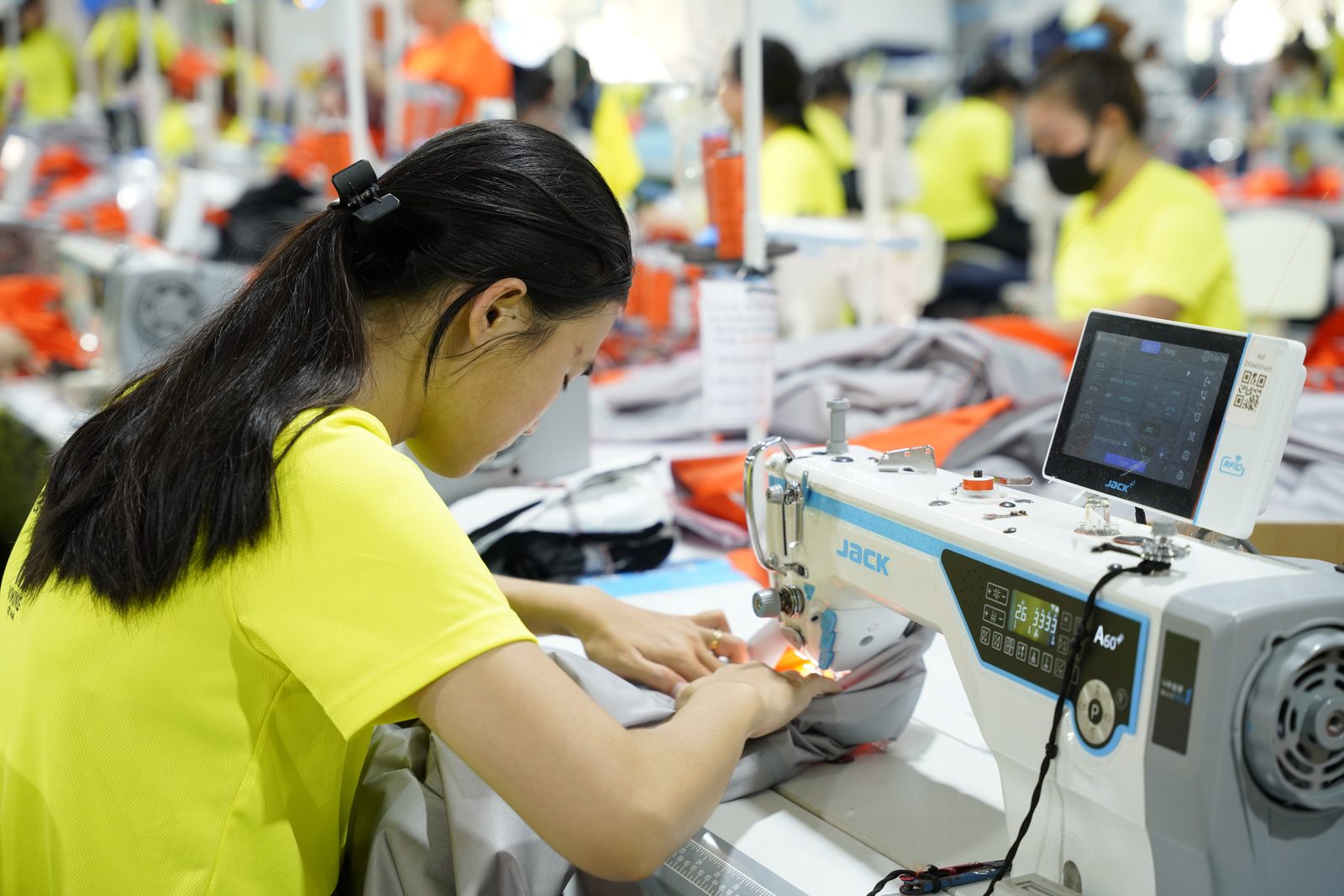
This data helps Viking Vietnam depend less on individual intuition when making decisions.
When customers work with Viking, they are not only working with an experienced factory. They are working with a system that is progressively standardising its production data in order to control better, improve faster, and respond more effectively to change.
This matters especially for orders with many styles, many colours, many sizes, many technical details, or tight delivery requirements.
8. IE helps keep bulk production consistent with the approved sample
One of the biggest concerns for customers is the difference between the approved sample and bulk production.
A sample may meet the requirement, but if the implementation process is unclear, bulk production can deviate in:
- Measurements
- Stitching
- Assembly sequence
- Position of details
- Stability of the operation
- Consistency between lines
- Completion schedule
IE helps reduce this risk by standardising the process, defining the operations, coordinating the layout, tracking implementation, and supporting line balancing after the sample is approved.
This allows the factory to maintain consistency between the original technical requirement and the reality of production.
For technical apparel, this consistency is especially important, because many details affect not only appearance but also how the product performs in use.
9. IE is the bridge between technical, production, QC and maintenance
In a factory, each department has a different point of view.
The technical team focuses on the product requirement.
Production focuses on schedule and productivity.
QC focuses on quality.
Maintenance focuses on machines and equipment.
The line leader focuses on the people and the flow of work on the line.
IE is one of the roles that connects these points of view through process, data, and a plan for organising production.
When IE works well, the departments share a common basis for discussion:
- Which process is being applied?
- Which operation needs support?
- Which machine needs to be prepared?
- Which layout is suitable?
- Where is actual productivity?
- Which bottleneck needs to be resolved?
This connection reduces misunderstanding, reduces fragmented work, and increases the ability to coordinate in production.
This is one of the reasons customers can feel more confident working with Viking Vietnam: production does not run department by department, but as a coordinated system supported by data.
10. IE helps Viking control production cost sensibly
In garment manufacturing, cost does not come only from material prices or labour rates. Cost also comes from wasted time, waiting for machines, an inefficient line arrangement, rework, unbalanced operations, or unclear production implementation.
IE helps the factory better control the factors that affect cost through:
- Analysis of operation times
- Calculation of operation costing
- Layout optimisation
- Reduction of waiting time
- Detection of bottlenecks
- Support for line balancing
- Standardisation of methods and the operation library
- Contribution to reducing deviation in production
For customers, this has a practical meaning. A factory that controls its process and productivity well has a better basis for maintaining stability in quality, schedule and cost over the long term.
Viking Vietnam does not see production optimisation as simple cost cutting. Production optimisation means making the process clearer, the data more accurate, and resources used more effectively.
11. IE in technical garment manufacturing must understand both process and product
For ordinary garments, operation analysis is already important. For technical products, this role becomes even more important.
Products such as waterproof garments, protective workwear, insulated jackets, outdoor apparel, or products with seam sealing, reflective details and technical fabrics usually have more complex requirements in:
- Assembly sequence
- Special machines
- Operations requiring high precision
- Areas requiring particular quality control
- Materials sensitive to heat, tension or handling
- Coordination between sewing, pressing, inspection and finishing
IE needs to understand not only what the operation is, but also why that operation matters within the whole structure of the product.
At Viking Vietnam, IE is part of the capability to produce demanding products, where every detail needs to be implemented correctly to ensure the stability of the finished garment.
12. Why customers can feel more confident when Viking has a clear IE system
When customers select a manufacturing partner, they need reassurance on three points:
- The product is understood correctly
- The process is implemented correctly
- Production is controlled correctly
The IE system helps Viking Vietnam strengthen all three.
With IE, a product is not put onto the line by intuition. It is analysed into a process, times, machines, layout and tracking data.
With IE, the sewing line does not simply run towards a general target. The line has a basis for knowing which operation to prioritise, which point needs support, and when an adjustment is needed.
With IE, customers gain further confidence that the factory does not only react when a problem appears, but has a mechanism to recognise and resolve problems earlier.
This capability is very important in export manufacturing, especially for brands that need a stable, transparent partner able to work alongside them over the long term.
Summary of operational value
- IE at Viking Vietnam plays an important role in bringing a product from sample to bulk production under control.
- IE supports building the sewing process, planning machine requirements, designing the layout, monitoring productivity and balancing the line.
- Data from IE helps the factory detect bottlenecks, improve processes, and depend less on individual intuition.
- IE is the bridge between technical, production, QC, maintenance and the line leader, helping the departments coordinate more effectively.
- For international customers, a clear IE system increases confidence in the ability to control quality, schedule and stability in bulk production.
Connect with Viking Vietnam
If you are looking for a garment manufacturing partner in Vietnam able to control the process, optimise productivity and maintain stable quality in bulk production, Viking Vietnam is ready to work with you.
We do not only manufacture to order. We build an operating system so that every product is implemented more clearly, controlled more closely, and delivered more reliably.
Connect with Viking Vietnam to develop technical apparel with a production process that is stable, transparent, and suited to the requirements of the global market.