In garment manufacturing, especially in the production of technical and high-performance apparel, a factory cannot grow sustainably by relying only on machines, output targets, or individual experience.
In garment manufacturing, especially in the production of technical and high-performance apparel, a factory cannot grow sustainably by relying only on machines, output targets, or individual experience. True manufacturing capability is built through people, teamwork, clear goals, and the ability of each department to take responsibility for the same result.
At Viking Vietnam, we call this operating mindset MIDAS TOUCH in production - a symbolic “golden hand” formed by five essential roles on the sewing line: the line leader, QC/QA, IE, maintenance, and technical implementation.
In Greek mythology, King Midas turned everything he touched into gold. At Viking Vietnam, the idea of “turning touch into gold” does not mean that everything becomes perfect from the beginning. It means that when five key roles work together in rhythm, follow SMART goals, and improve every day, a production line can create better productivity, more stable quality, and a stronger working environment.
This is one of the important foundations behind Viking Vietnam’s manufacturing capability.
Production Is Not Only About Speed - It Is About Doing Things Right Together
In a sewing factory, telling people to “increase productivity today” is not enough.
The operator needs to know what to do.
The line leader needs to know which operation is blocked.
QC needs to know which defect must be controlled.
IE needs to know the hourly productivity data.
Maintenance needs to know which machines must be prepared for the next style.
Technical implementation needs to know which operation requires clearer instruction.
When people only work by habit, the factory may still keep running. But to move toward a higher manufacturing standard, every activity needs clarity.
At Viking Vietnam, production effectiveness is built on five kinds of clarity:
-
Clear daily goals
-
Clear responsibility for each role
-
Clear data to monitor progress
-
Clear problems to solve
-
Clear deadlines for completion
When there is clarity, pressure becomes easier to manage. When roles are connected, production is no longer the burden of one person. It becomes the strength of a team.
MIDAS TOUCH: Five Roles That Create the Golden Hand of Production
A hand cannot be strong if one finger is missing. In the same way, a production line cannot operate effectively if the key roles do not work together.
At Viking Vietnam, these five roles form the MIDAS TOUCH production model.
1. The Line Leader: The Person Who Holds the Rhythm of the Line
The line leader is the captain of the sewing line.
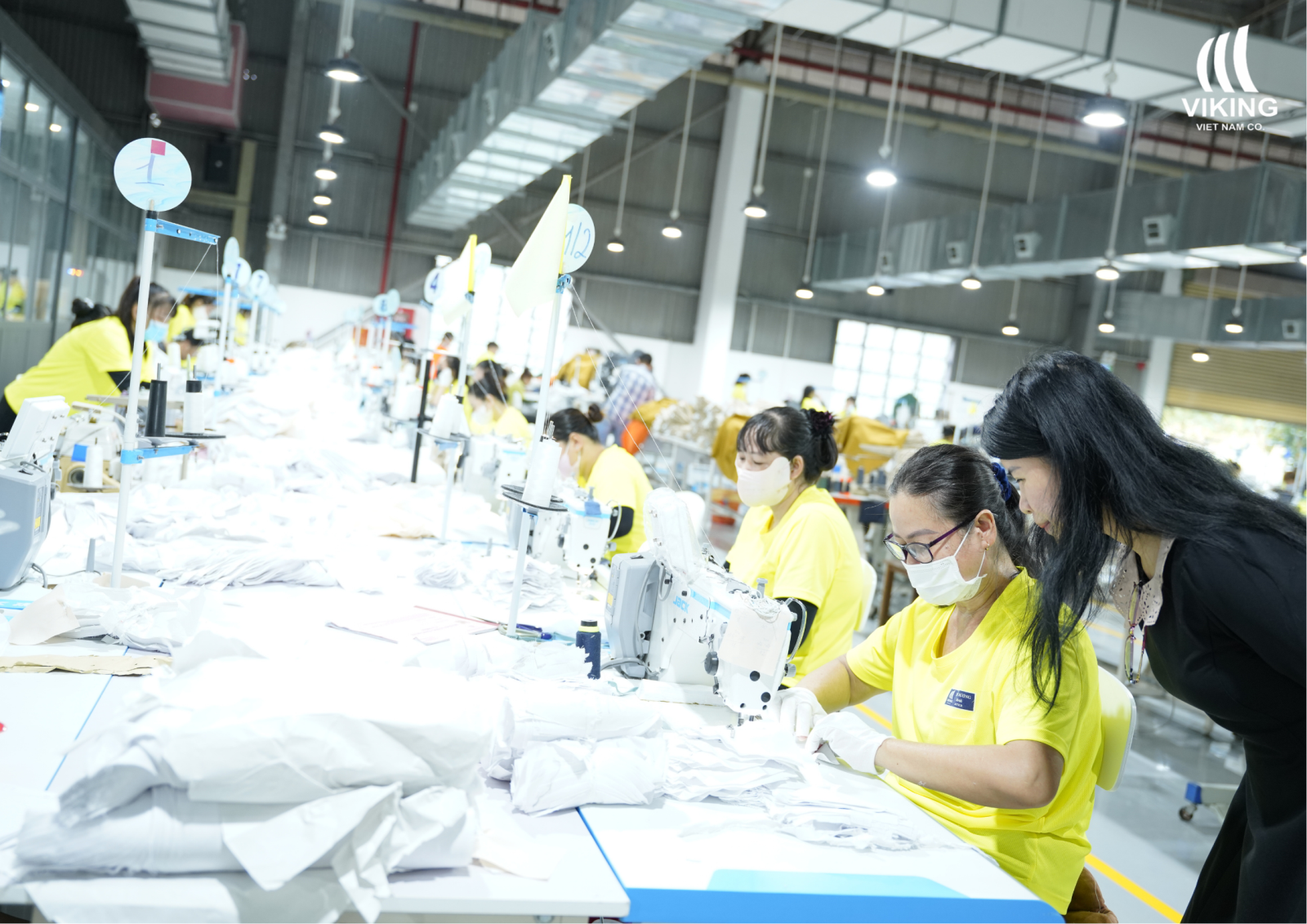
In a line of around 25 to 30 people, the line leader must see the full picture: who is doing which operation, which step is slowing down, which position needs support, which style should be prioritized, and what the daily target is.
A strong line leader does not only push for output. A strong line leader allocates people properly, keeps the working rhythm, connects with supporting departments, and helps the whole line focus on the shared goal.
The line leader is responsible for:
-
Defining the daily production target
-
Assigning workers based on skill and operation requirements
-
Monitoring line progress and productivity
-
Identifying bottlenecks during production
-
Coordinating with QC, IE, maintenance, and technical teams to solve problems
The line leader is like the conductor of an orchestra. Each operator is a note. Each operation is a rhythm. When the line leader holds the rhythm well, the whole line moves with greater harmony.
2. QC/QA: The Guardians of Quality from the Beginning
In technical garment manufacturing, quality cannot wait until final inspection. If a defect is found too late, the factory loses time, creates rework, affects delivery, and increases risk for the entire order.
That is why QC/QA is one of the most important “fingers” in the golden hand of production.
QC/QA helps the line to:
-
Detect defects early
-
Prevent repeated mistakes
-
Check products against technical standards
-
Guide operators to understand key quality points
-
Work with the line leader to balance quality and productivity
At Viking Vietnam, QC/QA is not only responsible for finding defects. They are responsible for preventing defects.
They help the production line understand customer requirements, control quality at the source, and protect product reliability before the goods leave the factory.
This role is especially important for export products, protective garments, waterproof apparel, seam-sealed products, and high-performance technical apparel.
3. IE: Turning Experience into Data
IE stands at the center of the golden hand.
In many production environments, decisions are often based on experience: this operation feels slow, this section seems overloaded, or this layout does not feel smooth. Experience is valuable. But when experience is supported by data, the production line becomes much stronger.
IE helps turn observation into numbers, layout, standard time, and line-balancing solutions.
The role of IE includes:
-
Measuring operation time
-
Analyzing work processes
-
Balancing the sewing line
-
Designing and updating layout
-
Monitoring hourly productivity
-
Identifying bottlenecks and proposing improvements
If the line leader holds the rhythm, IE helps make that rhythm more scientific.
Thanks to IE, the sewing line does not simply “try to work faster.” It knows exactly where to improve, which operation needs support, which section should be adjusted, and how actual productivity is changing.
This is the foundation of smart manufacturing: people remain at the center, but decisions are supported by data.
4. Maintenance: Keeping the Production Flow from Stopping
In a factory, machines are valuable only when they are properly prepared, stable, and ready to serve production needs.
The maintenance team at Viking Vietnam plays a critical role in keeping the sewing line from being interrupted by machine issues.
Their role includes:
-
Preparing machines for current and upcoming styles
-
Adjusting machines according to fabric and operation requirements
-
Supporting attachments, jigs, tools, and production improvements
-
Solving technical issues quickly
-
Helping operators work more smoothly, accurately, and safely
For technical apparel, maintenance becomes even more important. Different fabrics may require different machine settings. A difficult sewing detail may need a special attachment. A complicated operation, when improved by the maintenance team, can save time and reduce defects.
Maintenance does not only repair machines. Maintenance protects the production rhythm.
5. Technical Implementation: Bringing Standards Down to the Line
Even the most complete technical document cannot create a good product if the standard is not properly implemented on the sewing line.
The technical implementation team brings processes, product standards, sewing methods, and construction requirements into real production.
Their role includes:
-
Guiding operators on production methods
-
Supporting first-line samples
-
Explaining technical specifications
-
Solving technical problems during production
-
Proposing faster and more effective working methods
In high-performance garment manufacturing, this role is extremely important. A product may involve strict requirements for seams, seam sealing, reflective details, zippers, measurements, finished specifications, or the accuracy of multiple fabric layers.
Technical implementation ensures that standards do not remain on paper. Standards become correct actions on the production line.
SMART Goals: The Common Language of the Golden Hand
For these five roles to work effectively together, Viking Vietnam applies the SMART goal mindset in production.
SMART means:
-
Specific
-
Measurable
-
Achievable
-
Relevant
-
Time-bound
In production, a vague goal such as “try to do better today” does not create enough clarity.
A SMART goal is different.
For example: “Complete the remaining 51 pieces of this order by the end of today.” This kind of target helps everyone understand what must be done, how success will be measured, and when the work must be completed.
When a SMART goal is set, every role knows how to contribute.
The line leader knows how to allocate people.
QC knows which defects to focus on.
IE knows which operation to monitor.
Maintenance knows which machines must be prepared.
Technical implementation knows which operation needs support first.
In this way, the goal is no longer just a number on a board. It becomes the shared rhythm of the entire production line.
The Morning Meeting: Where the Production Rhythm Begins
At Viking Vietnam, a morning production meeting does not need to be long. But it must be clear.
This is the time when the key roles sit together to align on:
-
Which style or order must be completed today
-
What quantity target must be achieved
-
Which operation may become a bottleneck
-
Which defect needs to be solved completely
-
Who will support which area
-
When each task must be completed
The morning meeting helps the line begin the day proactively, not reactively.
Instead of waiting for problems to appear, the team identifies risks early. Instead of each department working separately, everyone places their piece into one shared production picture.
This is how Viking builds disciplined production rhythm.
When Five Roles Work Together, the Factory Builds Capability - Not Only Productivity
The strength of MIDAS TOUCH does not come from each role standing alone. It comes from the connection between them.
The line leader cannot create productivity alone without IE supporting line balance.
QC cannot protect quality if technical standards are not implemented correctly.
Maintenance cannot prepare well without knowing the next production plan.
IE cannot analyze accurately without real feedback from the line.
Technical implementation cannot support effectively without staying close to actual production issues.
When all five roles work together, the factory is not only solving daily tasks. It is building long-term operational capability.
This capability includes:
-
The ability to set clear goals
-
The ability to respond quickly to problems
-
The ability to coordinate across departments
-
The ability to control quality early
-
The ability to improve continuously at line level
This foundation helps Viking Vietnam serve international customers and produce garments with high technical requirements.
Production Efficiency Is Also a Way to Care for Workers
At Viking Vietnam, efficiency is not understood only as higher output. Efficiency also means helping workers do their jobs more smoothly.
When the line is well organized, operators spend less time waiting.
When technical instructions are clear, operators make fewer mistakes.
When QC detects defects early, operators reduce rework.
When maintenance prepares machines properly, operators face fewer interruptions.
When IE balances the line well, pressure becomes more evenly distributed across operations.
All these improvements help workers achieve more stable productivity, which can support better income and greater confidence at work.
For Viking, a strong factory is not a place that simply pushes people harder. A strong factory is a place where people understand the goal, receive the right tools, get the right support at the right time, and improve together every day.
.png)
Before Digitalization, Green Transformation, and AI - Build Strong People First
The garment industry is entering a new stage shaped by digitalization, sustainability, and artificial intelligence.
Many companies begin by asking: What software should we buy? What system should we install? Where should we automate?
At Viking Vietnam, we believe the first question should be deeper:
Do we already have strong human pillars who can operate change?
Software can provide data. But people must know how to read the data.
Machines can increase speed. But people must know how to operate them correctly.
AI can support analysis. But people must know how to ask the right questions.
Green standards can be applied. But people must practice them every day.
This is why Viking builds smart teams before talking about smart factories.
We build a culture of collaboration before talking about technology.
We build strong foundations at each sewing line before talking about Tier 1 capability.
MIDAS TOUCH: From an Operating Model to a Culture of Improvement
MIDAS TOUCH at Viking Vietnam is not only a production management model. It is a culture of improvement.
This culture begins when each person understands their role.
It grows when departments listen to each other and work together.
It becomes stronger when people are willing to look at numbers, identify problems, and find solutions.
It becomes sustainable when the team understands that the final goal is not only to complete the order, but also to raise their own capability every day.
The golden hand is not golden because everything becomes perfect instantly.
It is golden because each person places their hand in the right position, at the right rhythm, with the right responsibility.
That is how Viking Vietnam builds manufacturing capability from the inside.